

TLDR
This post helps Magic: The Gathering players understand MTG Emerge by explaining how the alternative cost works, what it can and cannot reduce, and which cards make the mechanic worth building around.
- Emerge lets you cast a spell for an alternative cost by sacrificing a creature, or a specific permanent type on newer variants like Emerge from artifact.
- The sacrificed permanent reduces only the generic portion of the Emerge cost. Colored mana still demands to be paid, because apparently Eldrazi have bookkeeping standards.
- Sacrificing the creature is part of casting the spell, so opponents cannot remove your sacrifice target in response once you begin casting.
- Emerge is strongest when you sacrifice creatures that already gave you value through enters, dies, or sacrifice triggers.
- For casual testing, Emerge decks are excellent proxy candidates because the card pool is weird, clunky, and oddly specific, which is Magic’s preferred love language.
Emerge is one of those MTG mechanics that looks simple until someone tries to sacrifice a token, reduce colored mana, cast a spell at instant speed, and then ask whether the commander tax has been politely escorted out of the building. The short answer is that MTG Emerge is an alternative casting cost. You sacrifice something, reduce the generic cost, and still follow normal casting rules. The long answer is where the fun lives, mostly because Magic rules text enjoys hiding trapdoors under perfectly normal sentences.
What Is MTG Emerge?
Emerge is a keyword ability that lets you cast a spell by paying its Emerge cost and sacrificing a creature rather than paying the spell’s normal mana cost.
The classic version appeared in Eldritch Moon, mostly on large colorless Eldrazi creatures with colored Emerge costs. That matters. A card can be colorless and still ask for blue, black, green, or red mana in its Emerge cost. The Eldrazi may not have colors, but they absolutely still send invoices.
Modern Horizons 3 expanded the mechanic with Emerge from artifact, seen on Crabomination. That variant works almost the same way, except the sacrificed permanent has to match the named quality. In Crabomination’s case, that means an artifact.
The basic template is:
“You may cast this spell by sacrificing a creature and paying the Emerge cost reduced by that creature’s mana value.”
For Emerge from artifact, replace “creature” with “artifact.” The key idea stays the same: sacrifice the right kind of permanent, subtract its mana value from the generic portion of the Emerge cost, then pay whatever remains.
How MTG Emerge Works Step by Step
Let’s use Elder Deep-Fiend, because if you are explaining Emerge and do not mention Elder Deep-Fiend, somewhere a 5/6 Eldrazi Octopus taps your lands out of spite.
Elder Deep-Fiend has:
- Mana cost:

- Emerge cost:


- Flash
- A cast trigger that taps up to four target permanents
Say you sacrifice a creature with mana value 3 while casting Elder Deep-Fiend for its Emerge cost.
The Emerge cost starts at . The sacrificed creature reduces the generic part by 3. That leaves  . You still pay both blue mana. No amount of sacrificing a six mana creature will pay the blue pips for you. Magic has many generous mechanics. This is not one of them.
If you sacrifice a creature with mana value 5 or greater, the generic portion can be reduced to zero, but you still pay . If the sacrifice has mana value 12, you still pay . The extra discount does not roll over into store credit.
What Emerge Can Reduce, and What It Cannot
The most common Emerge mistake is assuming the sacrificed creature reduces the whole cost. It does not. It reduces generic mana only.
| Situation | What happens |
|---|---|
| Sacrifice a mana value 3 creature to cast Emerge | You pay |
| Sacrifice a mana value 5 creature to cast Emerge | You pay |
| Sacrifice a mana value 8 creature to cast Emerge | You still pay |
| Sacrifice a 0 mana value token | You get no reduction |
Sacrifice a creature with  in its mana cost in its mana cost | X counts as 0 for mana value unless another rule says otherwise |
| Cast the spell for Emerge | The spell’s mana value does not change |
That last one matters. Elder Deep-Fiend still has mana value 8 even if you paid to cast it. Decimator of the Provinces still has mana value 10 even if you cast it for less. The cost you paid and the card’s mana value are not the same thing, which is good because otherwise half of Magic would need a spreadsheet and a small claims attorney.
Timing Rules: Emerge Does Not Make Everything Flash
Emerge does not change when you can cast a spell.
If the Emerge card is a creature without flash, you cast it at normal creature speed, usually during your main phase while the stack is empty. If the card has flash, like Elder Deep-Fiend, you can cast it at instant speed.
That is why Elder Deep-Fiend became the poster child for the mechanic. Flash turns Emerge from “large monster at a discount” into “surprise, your combat step is cancelled.” It can tap lands during upkeep, tap attackers before combat, or tap blockers before a lethal swing.
The mechanic itself does not grant flash. The card must already have it.
Sacrificing Is Part of the Cost
When you cast a spell with Emerge, choosing and sacrificing the creature happens as part of the casting process. Once you begin casting the spell, opponents do not get priority until you finish.
That means an opponent cannot respond by killing the creature you planned to sacrifice. They can respond to the spell after it is cast. They can counter the Emerge creature. They can make everyone at the table sigh. But they cannot stop the sacrifice by removing the creature after you have started casting the spell.
This is one of the best things about Emerge. Your sacrifice target is surprisingly safe during the casting process, which is impressive for something whose job description is “become food.”
Cast Triggers Still Matter If the Spell Is Countered
Many Emerge cards have “when you cast” triggers. That wording is important.
Elder Deep-Fiend taps permanents when you cast it, not when it enters. Wretched Gryff draws a card when you cast it. Decimator of the Provinces pumps the team when you cast it.
A cast trigger goes on the stack above the spell that caused it. It can resolve even if the creature spell is countered. So if you cast Elder Deep-Fiend and your opponent counters the creature, the tap trigger still happened unless they also counter the triggered ability.
That makes Emerge creatures much less embarrassing into counterspells. Not completely embarrassment-proof, because nothing in Magic is safe from a blue mage with untapped mana and a moral superiority complex, but better.
Emerge From Artifact and Other Variants
Modern Horizons 3 introduced Emerge from artifact with Crabomination.
Crabomination has Emerge from artifact  . Instead of sacrificing a creature, you sacrifice an artifact. The sacrificed artifact’s mana value reduces the generic part of the Emerge cost.
If you sacrifice Ichor Wellspring, a mana value 2 artifact, Crabomination costs  . If you sacrifice a Food token, the token has mana value 0, so you pay the full . Food is delicious, but it is not accounting value.
Crabomination also shows why this variant is interesting. Artifacts often want to be sacrificed anyway. Cards like Ichor Wellspring, Mycosynth Wellspring, Servo Schematic, and similar value artifacts can replace themselves or leave material behind. That lets you reduce the Emerge cost while keeping the exchange from becoming a tragic little two-for-one.
The Best Cards With Emerge
Not every Emerge card deserves a deck slot. Some are role players. Some are Limited nostalgia. Some ask you to jump through hoops for a reward that politely waves from across the room.
Here are the most important names to know.
| Card | Why it matters | Best home |
|---|---|---|
| Elder Deep-Fiend | Flash plus tap four permanents is still the cleanest Emerge play pattern | Tempo, Modern brews, Cube, Commander |
| Decimator of the Provinces | Turns a board into a sudden lethal attack | Creature-heavy Commander, casual ramp |
| Wretched Gryff | Draws a card on cast and gives you an evasive body | Limited style decks, value shells |
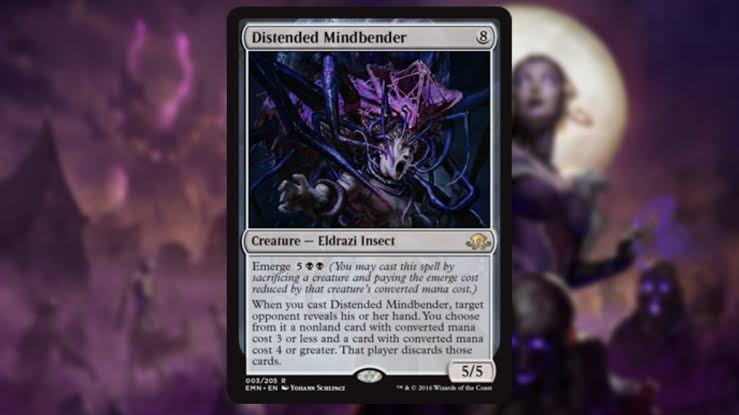
| Distended Mindbender | Attacks the opponent’s hand on cast | Midrange, discard shells |
| Vexing Scuttler | Returns an instant or sorcery from graveyard to hand | Spells and value decks |
| Foul Emissary | Finds a creature, then rewards you when sacrificed for Emerge | Green Emerge packages |
| Crabomination | Shows how Emerge from artifact can use sacrifice value | Artifact sacrifice decks |
| Herigast, Erupting Nullkite | Gives each creature spell you cast Emerge | Commander build-around |
In my opinion, Elder Deep-Fiend is still the cleanest example of why the mechanic works. Herigast is the most interesting Commander option because it turns Emerge from a small card package into a whole deck identity.
How to Build Around MTG Emerge
Emerge decks want sacrifice targets that have already done their job.
The dream is not sacrificing a random vanilla creature and calling it strategy. That is just feeding cardboard to a larger cardboard with better branding. The dream is sacrificing something that already drew a card, found a land, made a token, milled cards, drained life, or left something behind.
Good sacrifice targets usually fit one of these categories:
- Enters value: creatures like Solemn Simulacrum or Elvish Visionary that already replaced part of their cost
- Dies value: creatures with death triggers, recursion, or graveyard payoffs
- Mana value 3 or 4 creatures: these create the best early Emerge curve
- Artifact fodder for Emerge from artifact: eggs, Wellsprings, Clues, Blood tokens, and similar pieces
- Recursive creatures: threats that come back from graveyard or exile
- Creatures you wanted in the graveyard anyway: because some decks treat the graveyard like a second hand with worse lighting
The practical sweet spot is often mana value 3 or 4. A three mana creature lets you Emerge a seven cost card around turn four. A four mana creature can set up a large Emerge play on turn five. That does not mean every Emerge deck must follow that curve, but it is the cleanest place to start.
A Simple Emerge Deckbuilding Framework
Use this checklist before stuffing every tentacle-adjacent card into a deck and hoping the table respects your vision.
- Pick your payoff.
Are you building around Elder Deep-Fiend, Herigast, Crabomination, or a broader Eldrazi package? - Choose sacrifice targets that replace themselves.
If sacrificing a creature leaves you down a full card every time, your deck will eventually run out of furniture to throw into the portal. - Respect colored mana.
If your Emerge costs need, , or  , build your mana base accordingly. Generic discounts do not fix bad mana.
 - Prioritize cast triggers.
Emerge creatures with cast triggers are safer against counterspells and create value immediately. - Add recursion or token engines.
The more you can rebuild your board, the less your Emerge plan feels like selling your couch to buy a larger couch. - Test before buying expensive pieces.
Emerge decks can look brilliant in theory and then draw all top-end cards with no sacrifice targets. Testing is not optional unless you enjoy learning lessons through public suffering.
Emerge in Commander
Commander is where Emerge gets the most room to be strange.
Herigast, Erupting Nullkite is the obvious commander for the mechanic. Herigast has Emerge 
 , draws three cards when cast if you exile your hand, and gives each creature spell you cast Emerge with an Emerge cost equal to its mana cost.
That last line is the entire sales pitch. With Herigast on the battlefield, your giant creatures can eat smaller creatures to reduce their costs. Mono-red suddenly gets a weird sacrifice-ramp engine, which is exactly the kind of sentence Commander players pretend is normal.
A few practical Commander notes:
- Commander tax still applies when casting Herigast from the command zone.
- Emerge is an alternative cost, not a way to dodge additional costs.
- Cost reductions can apply to the total generic cost, but colored mana still must be paid.
- Herigast can sacrifice itself to help cast another creature spell after it grants Emerge, which is funny, legal, and very on brand for a giant Eldrazi Dragon.
For casual Commander, Emerge works best when your group is comfortable with big swingy turns. A tuned Herigast deck can create huge board states quickly. A casual Herigast deck can also spend several turns assembling a Rube Goldberg machine that produces one moderately annoyed dinosaur. Build for your table.
Emerge in Modern, Cube, and Casual Play
Elder Deep-Fiend has seen Modern experimentation, especially in older Simic or Temur shells that used value creatures and graveyard setup to power out tempo plays. It is not a defining Modern staple right now, but it remains a reasonable brew card.
That matters for expectations. If your goal is to win a Modern RCQ, Emerge probably is not the shortest path. If your goal is to build a clever, disruptive deck that makes opponents reread a card from Eldritch Moon and mutter “wait, that has flash?” then welcome home.
Cube is another good place for Emerge. The mechanic rewards sequencing, creature valuation, and sacrifice timing. Just make sure the Cube includes enough support. If you add Elder Deep-Fiend but no expendable value creatures, you have not added an archetype. You have added a lonely octopus.
Testing Emerge Decks With Proxies
Emerge is a great mechanic to test with proxies because the deckbuilding math is not obvious until you play games. You need to know whether your sacrifice curve works, whether your colored mana is reliable, and whether your giant payoff cards are actually worth the cardboard snacks.
For casual testing, use clearly marked playtest cards and talk to your table first. Proxy cards are for casual play, testing, budget access, and accessibility. They are not for trying to pass cards as authentic, and they are not for sanctioned events.
If you are unsure where proxies are allowed, read ProxyKing’s breakdown of MTG proxies at FNM and tournaments. If you are testing a full Commander shell, the guide to proxying a whole deck in MTG is also worth using before you spend money on cards that may spend most games glaring at you from your opening hand. For larger playtest lists, ProxyKing’s Print MTG Proxies page is relevant for casual deck testing and brewing.
Simple Rule 0 script:
“Quick note before we start: this is an Emerge test deck with readable proxies for casual play. Nothing is meant to pass as real cards. Are you okay with that, or should I switch decks?”
That is enough. You do not need a courtroom statement. You are asking to play Magic, not settle maritime law.
Common MTG Emerge Mistakes
Thinking Emerge reduces colored mana
It does not. Emerge only reduces generic mana. If the cost is , the most you can reduce is the .
Sacrificing a token and expecting a discount
Most tokens have mana value 0 unless they are copies of something with a mana cost. A random 1/1 token is a fine sacrifice if you need to cast the spell, but it will not reduce the cost.
Forgetting normal timing restrictions
Unless the spell has flash or another effect gives you permission, Emerge follows normal timing.
Missing cast triggers
Cast triggers happen before the creature resolves. They can still resolve even if the creature gets countered.
Trying to combine Emerge with another alternative cost
You cannot choose two alternative costs for the same spell. If you cast a spell for Emerge, you cannot also cast it for another “rather than paying its mana cost” option. You can still pay additional costs if allowed or required.
Final Thoughts
MTG Emerge is at its best when it turns creatures that already did their job into discounted monsters with immediate value. It is not just ramp. It is a trade. You are converting board presence into tempo, cast triggers, and oversized threats.
The mechanic rewards tight sequencing. Play the value creature. Get the card, land, token, or death trigger. Then let it become lunch for something with too many limbs and an alarming amount of rules text.
If you want the simplest place to start, build around Elder Deep-Fiend for tempo or Herigast for Commander. If you want the weirdest place to start, try Crabomination with artifact sacrifice value. Just remember the golden rule: Emerge discounts generic mana only. Colored pips still want their money.
FAQs
Does Emerge reduce colored mana in MTG?
No. Emerge only reduces the generic portion of the Emerge cost. If the cost is and you sacrifice a creature with mana value 7, you still pay .
Can my opponent destroy the creature I want to sacrifice for Emerge?
Not after you begin casting the Emerge spell. Sacrificing the creature is part of the cost, and players do not get priority during the middle of the casting process.
Do Emerge cast triggers resolve if the creature is countered?
Yes, cast triggers are separate from the creature spell. If you cast Elder Deep-Fiend, its tap trigger can resolve even if Elder Deep-Fiend itself gets countered.
Can I cast an Emerge creature at instant speed?
Only if the card has flash or another effect lets you cast it at instant speed. Emerge itself does not change timing.
Does Emerge work with commander tax?
Yes, commander tax still applies if you cast your commander from the command zone using Emerge. Emerge is an alternative cost, not a tax shelter. Cost reductions can reduce generic portions of the total cost, but colored mana must still be paid.
Are MTG proxies okay for testing Emerge decks?
For casual play and testing, proxies are commonly used if your group agrees. In sanctioned events, you generally need authentic cards, with limited judge-issued proxy exceptions for damaged cards during the event.
References
- Wizards of the Coast: Magic Comprehensive Rules
- Wizards of the Coast: Eldritch Moon Mechanics
- Wizards of the Coast: Eldritch Moon Release Notes
- Wizards of the Coast: Innistrad Remastered Release Notes
- Wizards of the Coast: Modern Horizons 3 Release Notes
- Scryfall: Emerge Card Search
- MTGGoldfish: Herigast, Erupting Nullkite Commander Decks
- MTGGoldfish: Elder Deep-Fiend Card Page