
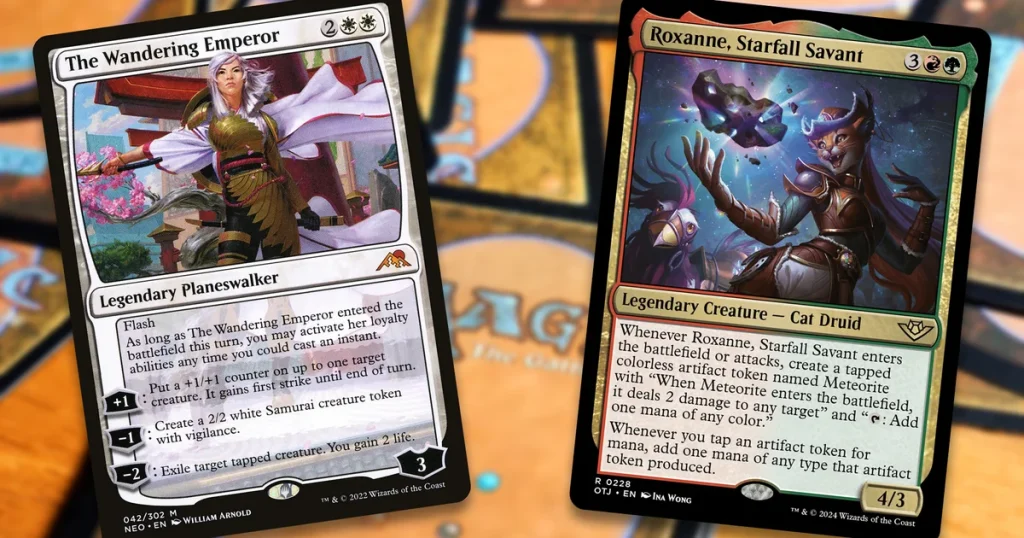
This post helps Commander players build a deck that actually does something on purpose by starting with a clear game plan, so they can win more games and tune faster (with fewer “why is this in here?” moments).
TLDR
- MTG Commander deckbuilding goes smoother when you pick a plan first, then choose ramp, draw, and interaction that serve that plan.
- Staples are fine. Staples as your entire personality is how you end up with a deck that “has answers” but never asks a question.
- Write your plan in 5 sentences. If you can’t, your deck is not done, it’s just expensive.
- Use a quick “role test” on every card: What job does this do for my plan and when?
- Proxies are great for playtesting and casual tables that agree to them. Sanctioned events are a different world.
You know the deck. You’ve played against it. You might have built it. MTG Commander deckbuilding turns into a late-night shopping spree where you add Sol Ring, Rhystic Study, Smothering Tithe, Dockside, a couple board wipes, and 14 cards you “just like.” Then you shuffle up and discover your deck’s primary win condition is hoping everyone else gets bored and leaves.
Staples are not the villain. The villain is building a deck with no plan and expecting the staples to improvise one for you.
Why “pile of staples” decks feel bad
A staple-heavy deck can still be strong, but it often feels clunky for three predictable reasons:
- Your cards disagree on what the deck is doing.
Half the list wants to grind. A quarter wants to combo. The rest wants to attack. Meanwhile your commander is standing there like a manager who scheduled three different shifts for the same person. - You draw “good cards” at the wrong time.
A turn-two value engine is great. A turn-ten mana rock is a coaster. A board wipe when you’re ahead is self-sabotage with extra steps. - Your deck has tools, not a story.
Commander games are long and messy. If you don’t know what your deck is trying to accomplish, you won’t know what hands to keep, what to tutor for, or when to spend interaction. You’ll just do… stuff. And “stuff” is rarely lethal.
So let’s fix it the boring way that works: start with a game plan.
MTG Commander deckbuilding starts with a plan you can say out loud
If you can describe your deck’s plan in a sentence, your deck will play better immediately. Not because you found secret tech, but because you will stop making random decisions that feel “safe.”
Here’s the five-sentence plan. Write it down. Yes, physically. No, your brain does not count as documentation.
The 5-sentence Commander game plan
- I win by: (combat damage, combo, commander damage, drain, lock, alt win, etc.)
- I get there by: (tokens, value engine, graveyard loop, spellslinger, stax, big mana, etc.)
- My commander’s job is: (engine, payoff, tutor, glue, finisher, or distraction)
- My backup plan is: (what you do when the main thing gets hated out)
- My biggest problem is: (fast decks, wipes, grave hate, counterspells, artifacts, etc.)
If you can’t fill this in, do not buy more cards. You are not “missing staples.” You are missing intent.
Example (simple on purpose)
- I win by: combat damage
- I get there by: making a lot of tokens and turning them sideways
- My commander’s job is: produce tokens or make tokens matter
- My backup plan is: anthem effects plus evasive threats
- My biggest problem is: board wipes and fog effects
Now every card you add has to help one of those lines. That’s how you stop building a pile.
Pick a deck identity: engine, pressure, or big finish
Most Commander decks are one of these, even if they pretend they’re “unique.”
1) Engine decks (value, synergy, combo)
Your plan is to assemble an engine that makes more resources than the table can handle.
Deckbuilding implication: you need redundancy, protection, and ways to find pieces.
Good questions:
- What are my engine pieces?
- How do I protect them?
- What happens if the engine dies twice?
2) Pressure decks (tempo, aggro, commander damage)
Your plan is to make the game uncomfortable early and never let it stabilize.
Deckbuilding implication: you need cheap threats, cheap interaction, and card flow that doesn’t cost your whole turn.
Good questions:
- What’s my “turn 4 board state” supposed to look like?
- How do I keep attacking after the first wipe?
- Do I actually have enough evasion, haste, or reach?
3) Big finish decks (battlecruiser, big mana)
Your plan is to survive long enough to slam something rude and end the game.
Deckbuilding implication: you need mana consistency, defensive interaction, and finishers that end games instead of “generate value.”
Good questions:
- Can I reliably cast my top end?
- How do I not die before turn 7?
- Do my “finishers” actually finish?
Pick one. You can blend later, but start with a lane. Commander rewards focus.
Build a deck skeleton: roles, not card names
This is where templates are useful, as long as you treat them like training wheels and not religious doctrine.
Here’s a practical skeleton that keeps you honest:
The role buckets
- Mana (lands + ramp + fixing)
- Card flow (draw, rummage, impulse, tutors if your group likes them)
- Interaction (spot removal, counterspells, protection, wipes)
- Plan enablers (the cards that make your deck “your deck”)
- Payoffs and finishers (how you convert setup into a win)
- Utility (grave hate, recursion, flexible tools)
The exact counts depend on your commander, curve, and pod. But the point is simple: if you load up on “good stuff” and forget plan enablers and payoffs, you built a toolbox with no project.
The “role test” for every card
Ask these two questions:
- What job does this do in my plan?
- What turn does it matter?
If you can’t answer, the card is either cuttable or it’s a pet card. Pet cards are allowed. Just admit what they are. Honesty keeps you from wondering why your deck feels weird.

Staples audit: keep the ones that help, cut the ones that cosplay as help
Staples become a problem when they are included by reflex.
Here’s a clean audit that saves you from yourself.
The 3-question staple filter
1) Does this advance my plan or only slow other people down?
Slowing people down can be part of a plan. It just can’t be your only plan unless you’re committed to that life.
2) Is this staple better here than a synergy piece?
A generic draw spell is great. A draw spell that also triggers your commander, fuels your graveyard, or makes tokens is usually better.
3) What is the opportunity cost?
Every time you add a staple, you are removing a card that could make your deck function as a coherent machine. You are trading identity for comfort.
A quick reality check: if you say “this card is good in every deck,” you are also saying “this slot is not helping my deck be special.” Sometimes that’s correct. Sometimes you are just avoiding decisions.
The “support package” rule: your plan needs infrastructure
A lot of decks fail because the builder added payoffs and forgot the boring stuff that makes payoffs castable and relevant.
Use this rule:
If your deck needs a thing to function, you need enough copies of that thing that you see it every game.
Examples:
- Token deck needs token makers and ways to profit from tokens
- Graveyard deck needs enablers (mill, discard), recursion, and answers to grave hate
- Spellslinger deck needs cheap spells, cost reduction or mana, and payoff triggers
- Voltron deck needs protection and evasion more than it needs one extra sword
This is also where your ramp and draw choices should match your plan. Your deck does not need “ten ramp.” Your deck needs “enough mana to do the thing on the turn the thing matters.”
Playtest loop: tune the plan, not the vibes
You do not need a spreadsheet. You need three notes per game.
After each game, write:
- How did I lose, specifically? (ran out of gas, mana screwed, wiped twice, combo raced, etc.)
- Which cards felt dead in hand? (name them, no mercy)
- Did I execute my plan at least once? (yes/no, and why)
Then change a small number of cards. Three is plenty. If you change fifteen cards at once, you are not tuning. You are rebooting. That is fine, but call it what it is.
Where proxies fit (without getting weird)
If a card is expensive and you’re still figuring out if it belongs, proxy it for playtesting and casual games where your group is cool with it. It is objectively smarter to test the plan first than to buy a cardboard mortgage payment and then realize it doesn’t fit.
Just keep the line clear: sanctioned events generally require authentic cards, with narrow judge-issued exceptions during the event for damaged cards. Casual Commander is a social agreement. Act like an adult and talk to your pod.
Three quick examples of “plan first” deckbuilding
Here’s what it looks like when the plan is doing the steering, not the staples.
Example 1: Token swarm
- Plan: flood the board, protect it, then close with an overrun effect
- Enablers: repeatable token makers, token doublers if your curve supports them
- Payoffs: anthems, sacrifice outlets, drains, finishers
- Staple choices change: you want draw that scales with creatures, and protection that saves a board
Example 2: Graveyard reanimator
- Plan: stock graveyard, cheat threats, loop value
- Enablers: self-mill, discard outlets, cheap recursion
- Payoffs: reanimation targets that end games or lock a board
- Staple choices change: you prioritize discard and mill synergy over generic draw that does not fill the yard
Example 3: Spellslinger
- Plan: cast lots of spells, turn casts into damage, tokens, or storm-like turns
- Enablers: cheap cantrips, cost reducers, mana bursts
- Payoffs: magecraft triggers, copying, pingers, finishers
- Staple choices change: interaction that is also a spell count matters more than clunky “good” cards that eat your whole turn
Same format. Same card pool. Very different decks. That’s the point.
When a pile of staples is actually fine
Sometimes you are building for an unknown pod, a new playgroup, or a meta that changes weekly. In that case, a midrange value plan is a real plan.
Just say it:
- I win by: value into finishers
- I get there by: outdrawing the table and trading efficiently
- My commander’s job is: card advantage engine
That is not a pile. That is a strategy. Boring, sturdy, and effective. Like a toaster.
FAQs
Do I need to follow a Commander deckbuilding template?
Templates help you avoid obvious failure modes (no draw, no ramp, no answers). But they are starting points, not laws. Your commander and plan decide the final numbers.
How many win conditions should I run in Commander?
Usually you want at least one primary win line and a backup that can still close a game. If your deck “wins eventually,” it often means it doesn’t win at all.
Are staples bad in Commander?
No. Staples are bad when they crowd out the cards that actually make your deck function. Use staples to support the plan, not to replace having one.
What’s the easiest way to tell if my deck has a real plan?
If you can explain how you win to a stranger in one sentence, you have a plan. If you start listing card names, you probably don’t.
Can I use proxies while I’m tuning a Commander deck?
For casual play and playtesting, many groups allow proxies if everyone agrees and the cards are readable. For sanctioned events, assume you need authentic cards except for narrow judge-issued proxy situations during the event.