
Hatsune Miku Secret Lair Cards in MTG: How They Play and Whether They’re Worth Adding
TLDR
- Hatsune Miku Secret Lair cards do not make MTG play differently just because they feature Miku art. Most are reprints or reskinned versions of existing cards.
- The strongest deck additions are the cards that were already good: Sol Ring, Swan Song, Counterspell, Chord of Calling, Brago, Giada, Feather, Azusa, and Chandra’s Ignition.
- They are worth adding if the original card already fits your deck or if you want a more personal Commander deck.
- They are usually not worth buying only for power. In many cases, the normal version of the card is easier to get and does the same thing.
- Actual Secret Lair cards are official cards where legal, but proxies and playtest versions belong in casual games where your table allows them.
The simplest way to think about Hatsune Miku Secret Lair cards is this: the Miku treatment changes the look, not the rules. A Miku card may look completely different from the normal printing, but in most cases it is still the same Magic card underneath.
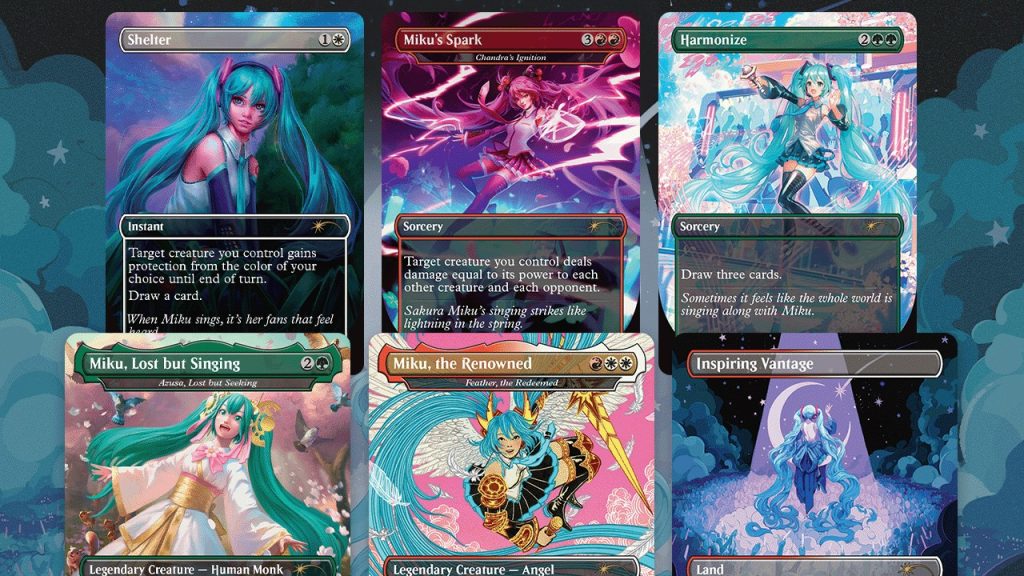
That matters for deckbuilding. Hatsune Miku Secret Lair cards can absolutely improve a Commander deck, but only when the actual card is already good in that strategy. Miku’s Spark is exciting because it is Chandra’s Ignition. Miku, the Renowned is exciting because it is Feather, the Redeemed. The art adds personality. The original card text does the work.
What Are Hatsune Miku Secret Lair Cards?
Hatsune Miku Secret Lair cards are special Magic: The Gathering cards released through the Secret Lair product line. Across the Miku drops, the cards use new art and, in some cases, alternate names that match the Hatsune Miku theme.
As of June 2026, the main Miku Secret Lair cards are spread across four seasonal-style drops:
- Sakura Superstar
- Digital Sensation
- Electric Entourage
- Winter Diva
These drops are not one unified deck. They are a collection of individual cards across different colors, card types, and strategies. Some are Commander staples. Some are build-around commanders. Some are just nice-looking alternate versions of cards that only fit specific decks.
That is the first mistake to avoid. Do not ask, “Are Miku cards good?” Ask, “Is this specific card good in my deck?”
Do Hatsune Miku Secret Lair Cards Affect Play?
Yes and no.
They affect play if the card itself is strong. They do not affect play because they are Hatsune Miku cards.
For example, Sol Ring is still Sol Ring. It is one of the most common Commander ramp cards because it gives you two colorless mana for one mana. The Miku version does not make it stronger, weaker, faster, or more legal. It just gives you a different version to sleeve up.
The same is true for Miku’s Spark. It is Chandra’s Ignition, a red sorcery that can turn one large creature into a board wipe and player-damage finisher. That card can end games in Voltron, big-creature, and commander-damage decks. The Miku art does not change that. It just makes the card feel different at the table.
This is the core rule:
If you would not play the normal version, do not add the Miku version just because it is Miku.
That does not mean style is irrelevant. Commander is a social format. People like decks that feel personal. A Miku-themed version of a card can make your deck feel more like yours. But the gameplay value still comes from the underlying card.
The Best Hatsune Miku Secret Lair Cards for Commander
Here are the cards I would look at first from a gameplay perspective.
| Miku Treatment or Card | Underlying Card | Best Deck Fit | Worth Adding? |
|---|---|---|---|
| Miku’s Spark | Chandra’s Ignition | Big creature, Voltron, commander damage | Yes, if your deck grows one creature |
| Miku, the Renowned | Feather, the Redeemed | Boros spellslinger, heroic, cantrip loops | Yes, as a commander or key creature |
| Miku, Lost but Singing | Azusa, Lost but Seeking | Lands, landfall, mono-green ramp | Yes, if extra land drops matter |
| Sol Ring | Sol Ring | Most Commander decks | Yes, where your table allows it |
| Chord of Calling | Chord of Calling | Creature toolbox, tokens, combo creatures | Yes, in creature-heavy decks |
| Miku, Child of Song | Child of Alara | Five-color control, board wipe commander | Yes, but only for a specific shell |
| Miku, Font of Pop | Giada, Font of Hope | Angel tribal | Yes, excellent in Angels |
| Miku, Queen Electric | Brago, King Eternal | Blink, value, control | Yes, but can get strong fast |
| Counterspell | Counterspell | Blue control, tempo, mid-power Commander | Yes |
| Swan Song | Swan Song | Blue Commander, combo protection | Yes |
| Miku, Voice of Power | Freyalise, Llanowar’s Fury | Elfball, green creature decks | Yes, especially as a planeswalker commander |
| Scrying Sheets | Scrying Sheets | Snow mana bases | Only if you run enough snow permanents |
That table also shows why a full “Miku deck” is awkward. The best cards pull you in different directions. Feather wants Boros spells. Azusa wants mono-green lands. Child of Alara wants five-color control. Giada wants Angels. Brago wants blink effects.
You can build a theme deck using as many Miku cards as possible, but it may not be the strongest way to play them.
Miku, the Renowned and Feather Decks
Miku, the Renowned is Feather, the Redeemed with a Miku treatment. This is one of the cleanest Commander options from the Miku drops because Feather is already a real build-around commander.
Feather wants cheap instants and sorceries that target your own creatures. Instead of going to the graveyard, those spells come back to your hand at the end of the turn. That lets you reuse protection spells, pump spells, and combat tricks.
This kind of deck can be fun because it is active. You are not just playing creatures and passing. You are protecting your board, drawing cards from targeted cantrips, and threatening sudden bursts of damage.
Miku’s Spark can also make sense in a Feather-style shell, especially if Feather or another creature gets large enough to make Chandra’s Ignition lethal. It is not automatic, though. Five mana is a lot, and the card needs a real creature on board. It is best when the deck already has pump, equipment, or a commander that can grow.
Miku, Lost but Singing and Land Decks
Miku, Lost but Singing is Azusa, Lost but Seeking. That means extra land drops.
Azusa is one of those commanders that looks simple and then quietly runs away with the game. Playing extra lands each turn gives you more mana, more landfall triggers, and better recovery after drawing a pile of lands.
This Miku card is worth adding if your deck already wants:
- landfall triggers
- big mana
- utility lands
- extra land drop effects
- ways to refill your hand
It is less useful if your deck has a normal land count and no payoff. Azusa is not “free ramp” by herself. You still need lands to play and cards to keep the engine moving.
Miku, Child of Song and Five-Color Control
Miku, Child of Song is Child of Alara. This is a very different kind of commander.
Child of Alara is a five-color legendary creature that can wipe the board when it dies. That makes it attractive for slower control decks that want repeated reset buttons. It also makes some casual tables nervous, because repeated board wipes can drag games out if the deck is not built carefully.
This is a good example of a card that is powerful, but not automatically fun for every pod.
Add it if you want a five-color control shell and your group is comfortable with that style of game. Skip it if your table prefers creature combat and fewer resets.
Miku, Font of Pop and Angel Decks
Miku, Font of Pop is Giada, Font of Hope. This is one of the easiest Miku cards to recommend for a specific tribe.
Giada is excellent in Angel decks because she ramps into Angels and adds +1/+1 counters as more Angels enter. The plan is clear, clean, and beginner-friendly: play Giada early, cast Angels, grow your board.
Youthful Valkyrie from Winter Diva also fits the same broad theme. It is not as powerful as Giada, but it belongs in many Angel decks because it grows as Angels enter the battlefield.
If you are building Angels, the Miku versions are not just collectibles. They are playable.
Miku, Queen Electric and Blink Decks
Miku, Queen Electric is Brago, King Eternal. Brago is a classic blink commander.
Brago decks attack, deal combat damage, and then exile and return your nonland permanents. That can reuse enters-the-battlefield triggers, reset mana rocks, refresh value engines, and create very strong board states.
This is one of the more powerful Miku options, but it comes with a warning. Brago can become oppressive if you build it with heavy lock pieces or repetitive value loops. At casual tables, I would keep the deck honest unless your group already likes higher-power Commander.
As a card, though, Brago is very real. If you want a Miku-themed commander that can actually win games, this is one of the strongest choices.
The Blue Staples: Counterspell and Swan Song
Counterspell and Swan Song are not flashy, but they are two of the most broadly useful cards from the Miku drops.
Counterspell is simple: two blue mana, counter target spell. It is clean interaction.
Swan Song is narrower, but often stronger in Commander because it costs only one blue mana and stops many of the scariest spells in the format: board wipes, tutors, combo pieces, protection spells, and opposing interaction. Giving someone a 2/2 Bird is usually worth it.
These cards are worth adding if your deck can support blue mana and wants efficient interaction. They do not need a Miku theme. They just need a deck that wants to survive long enough to do its thing.
Are Hatsune Miku Secret Lair Cards Worth Buying for Power?
Usually, no.
They are worth buying for power only if the specific card is something you already needed and the price makes sense compared to other versions. Secret Lair cards often carry collector demand, especially crossover cards with a popular character. That means the price may reflect the art and fandom as much as the gameplay.
For deck performance, the normal version works the same.
That does not make the Miku cards a bad buy. It just means the reason matters.
Buy or trade for them if:
- you like Hatsune Miku
- you enjoy Secret Lair collecting
- the card already fits your deck
- you want a commander deck with a more personal look
- the price is reasonable to you
Skip them if:
- you are only trying to make your deck stronger
- the normal version is much cheaper
- the card does not match your strategy
- your deck would rather have a different effect
Magic players are great at convincing themselves that a cool card is secretly a deck upgrade. Sometimes it is. Sometimes it is just a cool card.
Actual Secret Lair Cards vs Proxies
There is an important difference between official Secret Lair cards and proxies.
An actual Hatsune Miku Secret Lair card is an official Magic card. It follows normal legality rules for the underlying card. If that card is legal in your format, the Secret Lair version is generally usable as that card.
A proxy or playtest version is different. ProxyKing proxies are intended for casual play, Commander nights, cubes, and playtesting where proxies are allowed. They are not for sanctioned events, and they should never be represented as authentic cards.
That distinction matters if you want to test a deck before chasing collectible versions. You can use proxies to see whether Miku’s Spark, Brago, Giada, Azusa, or Feather actually belong in your deck. Then, if you love the build, you can decide whether the official Secret Lair version is worth the extra cost.
For a broader setup guide, read ProxyKing’s article on the best ways to proxy a whole deck in MTG.
For casual Commander, the table conversation matters too. ProxyKing’s guide on how many proxies are too many in MTG Commander gives a useful framework: consent, clarity, and calibration.
How to Decide Which Miku Cards Belong in Your Deck
Use this quick filter before adding any Hatsune Miku Secret Lair cards:
- What is the original card?
- Is that card legal in my format?
- Does my deck already want this effect?
- Is the mana cost realistic?
- Does it support my win condition?
- Am I adding it for gameplay, collection value, or both?
That last question is not a trap. It is fine to add a card because you like it. Commander is supposed to have room for personality. But it helps to be honest about why the card is there.
A Miku Sol Ring is a gameplay card and a style card. A Miku-themed planeswalker that does not support your deck may just be a style card. Both can be fine. Only one is likely to help you win.
Best Miku Cards by Deck Type
Here is the cleaner recommendation list.
For most blue decks: Counterspell and Swan Song.
For most Commander decks: Sol Ring, assuming your table and format allow it.
For creature toolbox decks: Chord of Calling.
For Angel decks: Miku, Font of Pop and Youthful Valkyrie.
For blink decks: Miku, Queen Electric.
For land decks: Miku, Lost but Singing.
For Boros spellslinger: Miku, the Renowned.
For Elf decks: Miku, Voice of Power.
For big creature decks: Miku’s Spark.
For five-color control: Miku, Child of Song.
That is the real value of the Miku Secret Lair cards. You do not need all of them. You need the ones that match your deck’s plan.
Conclusion
Hatsune Miku Secret Lair cards affect MTG play the same way any reprint affects play: through the card text that was already there. The Miku art, names, and styling make the cards more collectible and more personal, but they do not create a new Miku mechanic or a secret deck archetype by themselves.
The best cards are easy to identify. Sol Ring, Swan Song, Counterspell, Chord of Calling, Brago, Giada, Feather, Azusa, and Chandra’s Ignition all have real homes in Commander. The rest depend more heavily on your deck’s strategy.
My practical answer: do not buy a full Miku drop just to power up a deck. Buy or proxy-test the individual cards that already make sense for your list. Then choose the Miku version when you want the deck to feel more personal.
That is where these cards are at their best: not as raw power upgrades, but as playable style upgrades.
FAQs
Do Hatsune Miku Secret Lair cards have different rules?
No. In most cases, they are alternate versions, reprints, or reskins of existing Magic cards. The gameplay comes from the underlying card.
Is Miku’s Spark the same as Chandra’s Ignition?
Yes. Miku’s Spark is the Miku treatment of Chandra’s Ignition. Deckbuilders should evaluate it as Chandra’s Ignition.
Can Miku, the Renowned be my Commander?
Yes, because it is Feather, the Redeemed. It works as a Boros commander for decks built around targeting your own creatures with instants and sorceries.
Are Hatsune Miku Secret Lair cards good in Commander?
Some are excellent. Sol Ring, Swan Song, Counterspell, Chord of Calling, Brago, Giada, Feather, Azusa, and Chandra’s Ignition are the main standouts.
Should I build a deck using every Miku card?
You can, but it will probably be more of a theme deck than an optimized deck. The cards are spread across different colors and strategies, so they do not naturally form one clean archetype.
Can I use proxy versions of Miku cards?
For casual play and playtesting, yes, if your table allows proxies. For sanctioned events, use authentic cards and follow the event’s rules.
Share this Post
Product Categories
- Lorcana3535 products
- MTG Proxy Cards23032303 products
- MTG Proxy Sets2323 products
- Artifact351351 products
- Black310310 products
- Blue261261 products
- Colorless6666 products
- Green283283 products
- Land MTG Proxy Cards444444 products
- Multi-Colored202202 products
- Red176176 products
- White212212 products
- Pokemon2626 products
Recent Posts
- Protection From a Color in MTG: Damage, Enchanting, Blocking, and Targeting
- ProxyKing Customer Service: What Our Hands-On Testing Says About the Current Operation
- Best Expensive Counterspells to Proxy for High-Power Commander Testing
- How to Proxy Reserved List Cards for a Cube Without Rebuilding the Whole Cube
- Best Fetch Lands to Proxy for Commander and Multi-Deck Testing