
MTG Ravnica Guilds: Lore Guide to All 10 Guilds
TLDR
- The MTG Ravnica guilds are ten powerful factions that rule the city-plane of Ravnica, with each guild tied to one two-color mana pair.
- Each guild has a civic function, a philosophy, a political agenda, and at least one reason everyone else wishes they would calm down.
- The Guildpact originally forced the guilds into balance, but Ravnica’s story has repeatedly broken, rebuilt, and stressed that balance.
- As of the post-Phyrexian invasion era and Murders at Karlov Manor, some guilds are stable, some are wounded, and the Golgari are basically holding a leadership knife fight in a compost heap.
- If you are building guild-themed Commander decks, proxies are useful for testing expensive lands, commanders, and flavor packages before committing to the real cards.
Welcome to Ravnica, where every civic department has a private army
The MTG Ravnica guilds are the heart of one of Magic: The Gathering’s most famous settings. Ravnica is a city that covers an entire plane, which sounds impressive until you realize it also means every neighborhood dispute has ten magical factions, six legal codes, a sewer necromancer, and probably a dragon involved.
Ravnica’s ten guilds are not just deck color names. They are governments, religions, research institutes, military orders, criminal networks, labor systems, cults, and ideological disasters wearing matching uniforms. Each guild controls a different part of Ravnican life, and each one embodies a two-color combination in Magic.
That is why players still say “Izzet deck,” “Orzhov deck,” or “Golgari strategy” long after leaving the plane itself. The guild names became shorthand for how color pairs feel, play, and argue with each other across the table.
What are the MTG Ravnica guilds?
The MTG Ravnica guilds are ten sociopolitical factions bound to the structure of Ravnica by the Guildpact, an ancient magical agreement originally created to end war between the guilds and assign each one a role in the city’s infrastructure.
Here is the quick version:
| Guild | Colors | Civic role | Lore vibe |
|---|---|---|---|
| Azorius Senate | White / Blue | Law, courts, legislation | Bureaucracy with magical handcuffs |
| Boros Legion | White / Red | Military and peacekeeping | Righteous soldiers with angelic management |
| House Dimir | Blue / Black | Information, spies, secrecy | The secret police pretending not to exist |
| Izzet League | Blue / Red | Utilities, engineering, research | Mad science with a municipal budget |
| Simic Combine | Green / Blue | Medicine, biology, adaptation | Public health, now with crab claws |
| Selesnya Conclave | Green / White | Community, nature, spiritual unity | Communal harmony with a very large army |
| Orzhov Syndicate | White / Black | Banking, religion, contracts | Church, bank, mafia, ghost HR department |
| Cult of Rakdos | Black / Red | Entertainment, labor, spectacle | Circus violence as a public service |
| Golgari Swarm | Black / Green | Waste, death, food, undercity life | Compost, fungus, zombies, social resentment |
| Gruul Clans | Red / Green | Former wilderness protectors | Urban demolition therapy |
The important thing is that each guild is both practical and ideological. The Azorius do not just write laws because somebody has to. They write laws because they believe law itself is civilization. The Rakdos do not just perform because Ravnica needs entertainment. They perform because life is short and someone has to set the stage on fire.
Reasonable people would compromise. Ravnica has very few reasonable people in leadership.
Azorius Senate: white-blue law without the fun parts
The Azorius Senate is Ravnica’s government, court system, and legal enforcement machine. If Ravnica has a rule about where you may park your thopter, the Azorius wrote it, stamped it, filed it, revised it, and then arrested someone for incorrectly citing subsection seven.
The guild was founded by Azor I, the sphinx who helped create the Guildpact. That origin explains a lot. Azorius philosophy is built around the belief that civilization survives through control, procedure, prediction, and restraint. Their magic reflects that: detainment, counterspells, law magic, and effects that stop players from doing things. Truly beloved at kitchen tables everywhere.
In the story, the Azorius have gone through several major leaders, including Grand Arbiter Augustin IV, Isperia, Dovin Baan, and Lavinia. As of the post-War of the Spark and post-invasion era, Lavinia serves as acting guildmaster, trying to keep the legal system moving while Ravnica recovers from events that were, inconveniently, not fully covered by existing statutes.
Lore takeaway: Azorius is what happens when white’s order and blue’s planning decide that freedom is mostly a paperwork error.
Boros Legion: white-red justice with swords drawn
The Boros Legion is Ravnica’s military force and one of its main peacekeeping bodies. Where the Azorius write the law, the Boros kick down the door when someone violates it loudly enough.
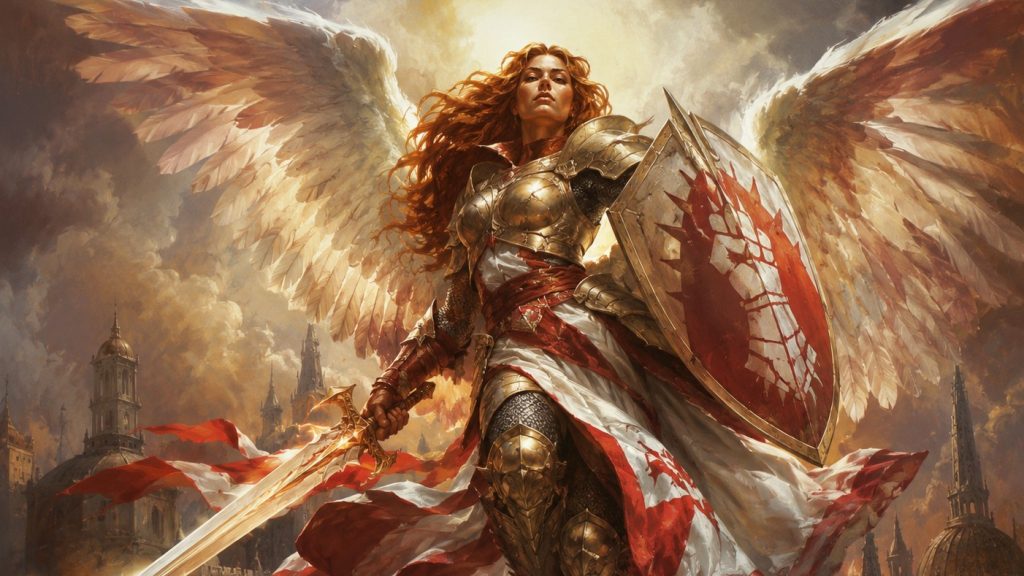
The guild was founded by Razia, a powerful angel who shaped the Boros into a disciplined, zealous army. Later, Aurelia became guildmaster and pushed the Legion into a more aggressive, active role. Aurelia is not the sort of leader who asks whether the situation calls for military force. She starts there and lets the details catch up.
The Boros combine white’s devotion to justice with red’s passion and fury. That makes them heroic at their best and dangerously self-righteous at their worst. On Ravnica, they protect civilians, fight riots, battle monsters, and clash constantly with guilds like Rakdos, Gruul, Golgari, and Simic.
After the Phyrexian invasion, the Boros are badly depleted and carrying guilt over their inability to protect the plane completely. Their response has been to recruit heavily and crack down harder. Subtle healing process, obviously.
Lore takeaway: Boros is the guild for players who believe justice should arrive with wings, armor, and several combat steps.
House Dimir: blue-black secrets that may or may not exist
House Dimir is Ravnica’s spy network, information brokerage, assassination machine, and long-running conspiracy theory. For thousands of years, many citizens believed the Dimir were a myth. This was not because the Dimir were harmless. It was because they were very good at making people forget otherwise.
The guild was founded by Szadek, a psychic vampire and one of Ravnica’s original paruns. Szadek’s schemes helped break the original Guildpact, which is quite an achievement if your resume already includes “secret vampire founder of an invisible espionage guild.”
Modern Dimir is associated with Lazav, a shapeshifting guildmaster who prefers masks, misinformation, and never being where people think he is. After Ravnica’s recent disasters, the Dimir have tried to fade back into ambiguity. Publicly, they print news sheets and manage information. Secretly, they shape what the public knows, what it suspects, and what it conveniently never hears about.
Lore takeaway: Dimir is blue-black at its purest, knowledge as power, secrecy as armor, and murder as an administrative tool.
Izzet League: blue-red science, infrastructure, and regrettable explosions
The Izzet League handles Ravnica’s public works: heating, water, roads, power systems, magical engineering, and experiments that begin with “technically this should work.”
Founded and long led by Niv-Mizzet, the Izzet are brilliant, reckless, and almost allergic to waiting for peer review. Niv-Mizzet is one of Magic’s most important dragons, a genius who turned his guild into a citywide engine of innovation. Later, after the War of the Spark, Niv-Mizzet became the Living Guildpact, leaving Ral Zarek to function as guildmaster and lead much of the League’s reconstruction work.
The Izzet are not chaos for chaos’s sake. That is Rakdos’s department. The Izzet want discovery. They want invention. They want the city to run better. They also want to test the experimental boiler today because tomorrow is so far away and the paperwork looks boring.
Lore takeaway: Izzet is the color pair for people who ask “what if?” and then answer by vaporizing a laboratory wall.
Simic Combine: green-blue medicine that got extremely ambitious
The Simic Combine is responsible for public health, biological research, and the preservation or improvement of life on Ravnica. That sounds wholesome until you meet the giant hybrid sea creatures.
Originally, the Simic were tied to medicine and ecological preservation. Over time, they embraced biomancy, mutation, and adaptive evolution. Their philosophy often turns on the tension between nature as something to protect and nature as something to improve. The Simic answer is usually “both,” followed by attaching fins to something that did not request fins.
Past leaders include Momir Vig and Prime Speaker Zegana. In current lore, Prime Speaker Vannifar holds power, though her position is politically fragile after the invasion and internal Simic conflict. The Simic are trying to rebuild trust by offering healing and medical treatment, even after some members made catastrophically bad choices around Phyrexian compleation.
Lore takeaway: Simic is green-blue curiosity with a scalpel. Sometimes it saves lives. Sometimes it creates a Sharktocrab. These are the risks of innovation.
Selesnya Conclave: green-white unity with roots and teeth
The Selesnya Conclave represents community, nature, spiritual unity, and collective purpose. Outsiders often see them as a serene nature religion. Outsiders are not entirely wrong, but they are also standing very close to the army of wolves, dryads, elementals, elves, and wurms.
The Conclave is tied to Mat’Selesnya, the Worldsoul, and Vitu-Ghazi, the enormous world-tree at the center of Selesnya life. Trostani, a trio of dryads, traditionally serves as the guild’s voice and leader. The Conclave preaches harmony, selflessness, and balance between civilization and nature.
After the Phyrexian invasion, Selesnya withdrew inward, focusing on its own recovery and refusing much outside help. More recently, it has begun opening back up, though rumors suggest internal strain and uncertainty around Trostani and the guild’s connection to the Worldsoul.
Lore takeaway: Selesnya is what happens when green’s life force and white’s community structure decide individuality is suspiciously untidy.
Orzhov Syndicate: white-black wealth, religion, and debt after death
The Orzhov Syndicate is one of the sharpest pieces of Ravnica satire. It is a church. It is a bank. It is an organized crime family. It is also a spiritual debt trap where death does not necessarily get you out of your payment plan.
The Orzhov present themselves through ritual, hierarchy, and religious authority. Underneath that, they exist to funnel wealth upward through contracts, loans, tithes, favors, and magical obligation. The old Ghost Council, the Obzedat, once ruled as immortal oligarchs. Kaya destroyed them and briefly became guildmaster, but Teysa Karlov later seized control.
As of Murders at Karlov Manor era lore, Teysa is the guildmaster, while Tomik Vrona handles much of the day-to-day operation. The Orzhov have also funded public rebuilding, partly for influence, partly for profit, and partly because public relations is cheaper than repentance.
Lore takeaway: Orzhov is white-black order and ambition, where every promise has fine print and every fine print has a ghost attached.
Cult of Rakdos: black-red spectacle with casualties included
The Cult of Rakdos is Ravnica’s entertainment guild, though “entertainment” is doing a heroic amount of work there. They run carnivals, nightclubs, performances, festivals, labor crews, and the kind of public events where the waiver is probably longer than the show.
The guild is led by Rakdos himself, an ancient demon who embodies hedonism, cruelty, chaos, and theatrical violence. He is technically the guildmaster, although he often spends long stretches uninterested in administration. Which, to be fair, is probably healthier than him taking an active management role.
Rakdos performers mock authority, reject control, and celebrate the brief intensity of life before death. At their best, they are a release valve for Ravnican misery. At their worst, they are murder clowns with funding.
After the invasion, the Cult of Rakdos expanded its spectacles as Ravnicans sought distraction from trauma. The Boros, as you might expect, have not found this therapeutic.
Lore takeaway: Rakdos is black-red freedom, pleasure, violence, and performance. Your deck may be fun. Your audience may not survive it.
Golgari Swarm: black-green life, death, rot, and survival
The Golgari Swarm lives in Ravnica’s undercity and controls the cycle of waste, decay, food production, death, and rebirth. They are the reason the city does not drown in garbage and corpses. Naturally, everyone looks down on them because Ravnica is a city committed to hypocrisy at scale.
The Golgari understand that death is not an ending. It is material. Food grows from rot. Power rises from the forgotten. The dead can work. Fungus can feed the poor. Zombies can solve labor shortages. It is practical, unsettling, and very black-green.
The Swarm has had many rulers, including Svogthir, Savra, Jarad, Vraska, and various faction leaders. In current post-invasion lore, the Golgari are in crisis. Vraska disappeared after the invasion, and the guild has no acting head. Internal factions want power, but no one has secured it.
Lore takeaway: Golgari is black-green realism. Everything dies, everything feeds something else, and the undercity remembers who threw what away.
Gruul Clans: red-green rage against the city
The Gruul Clans were originally supposed to protect Ravnica’s wild places. Then Ravnica did what cities do and paved over nearly everything. The other guilds ignored the Gruul, marginalized them, and reduced their purpose to a historical footnote. The Gruul responded by becoming a collection of furious clans dedicated to breaking civilization apart.
Hard to say nobody warned anyone.
The Gruul are not a neat government. They are fractured clans, rubblebelt warbands, shamans, warriors, beasts, and anarchic communities united by resentment and primal instinct. Borborygmos has often been treated as a central figure, especially through the Burning-Tree Clan, but the Gruul are not built for tidy leadership charts. The clans follow strength, omens, rage, and opportunity.
After the invasion, the Gruul seized ruined territory and disrupted rebuilding efforts. From their perspective, ruined city blocks are not damage. They are progress.
Lore takeaway: Gruul is red-green rebellion, instinct, destruction, and nature punching concrete in the face.
Which Ravnica guild has the best lore?
The honest answer depends on what kind of story you like.
If you like political intrigue, choose Dimir, Orzhov, or Azorius. If you like war stories and tragic heroism, Boros is the obvious pick. If you want cosmic weird science, Izzet and Simic are loaded with flavor. If you like social collapse, old wounds, and “the city was the villain all along,” Gruul and Golgari are excellent. If you enjoy theatrical menace, Rakdos is standing on a stage somewhere with a flaming scythe and absolutely no insurance.
For deckbuilding, the best guild is usually the one whose philosophy matches the way you want to win. Azorius controls. Rakdos burns resources fast. Golgari grinds through the graveyard. Simic ramps and adapts. Boros attacks with conviction and occasionally a concerning lack of backup plans.
Building guild-themed decks with proxies
Ravnica decks are easy to make flavorful because the guild identities are so strong. You can build around guild leaders, mechanics, shock lands, signets, charms, guildmages, split cards, and legendary creatures from each Ravnica visit.
The expensive part is not always the flashy commander. Often it is the mana base. Shock lands, fetch lands, and high-demand staples can add up quickly. If you want to test a guild deck before buying every card, ProxyKing’s Print MTG Proxies page can help you playtest a full list for casual games.
A clean approach:
- Build the deck around one guild identity.
- Add the guild’s key legends and mechanics.
- Proxy the expensive lands and staples first.
- Play three to five games.
- Cut the cards that only looked good in theory, also known as “the most Commander experience possible.”
For bigger projects, like a ten-guild battle box or Ravnica cube, read ProxyKing’s guide to proxying a whole MTG deck. If you plan to play outside your kitchen table group, check the rules around using MTG proxies at FNM or tournaments. Casual proxy testing is one thing. Sanctioned events are another, and judges do not accept “but the lore was really good” as a deck registration note.
Final thoughts on the MTG Ravnica guilds
The MTG Ravnica guilds work because they are not just factions with logos. They are complete civic philosophies in conflict. Every guild is necessary, every guild is dangerous, and every guild is convinced it is the reasonable one.
That tension is why Ravnica keeps coming back. The plane can support crime stories, war stories, political thrillers, mad science, religious corruption, ecological revenge, comedy, horror, and deckbuilding shorthand all at once. It is a city where the sewer farmers, angel soldiers, ghost bankers, secret assassins, and exploding engineers all technically serve the public.
No wonder the paperwork is a nightmare.
FAQs
What are the ten guilds of Ravnica in Magic: The Gathering?
The ten Ravnica guilds are Azorius Senate, Boros Legion, House Dimir, Izzet League, Simic Combine, Selesnya Conclave, Orzhov Syndicate, Cult of Rakdos, Golgari Swarm, and Gruul Clans.
What is the Guildpact?
The Guildpact is the magical agreement that originally bound the ten guilds to specific roles on Ravnica. It was created to end a massive war and keep the guilds in balance. The original Guildpact was later broken, and the role of Living Guildpact has shifted in the story, most notably to Jace Beleren and later Niv-Mizzet.
Which Ravnica guild is blue-red?
The blue-red guild is the Izzet League. In lore, the Izzet handle infrastructure, engineering, magical research, and reckless experimentation under the legacy of Niv-Mizzet and the leadership of Ral Zarek.
Which Ravnica guild is black-green?
The black-green guild is the Golgari Swarm. The Golgari live largely in the undercity and handle death, decay, waste, food production, fungus, necromancy, and survival.
Are Ravnica guild names used outside Ravnica sets?
Yes. Magic players commonly use Ravnica guild names as shorthand for two-color combinations. For example, “Orzhov” means white-black, “Simic” means green-blue, and “Boros” means white-red, even when the deck has no Ravnica cards.
Can I use proxies for Ravnica guild decks?
In casual play, proxies are often fine if your group allows them and the cards are clear playtest pieces. In sanctioned events, player-made proxies are not allowed, except for narrow judge-issued situations. Ask your group or organizer before playing.
References
- Wizards of the Coast, Ravnica Plane Page
- Wizards of the Coast, Ravnica, Then and Now
- Wizards of the Coast, A Flavorful Guide to the Guilds of Ravnica
- Wizards of the Coast, A Flavorful Guide to the Guilds of Ravnica Allegiance
- Wizards of the Coast, Planeswalker’s Guide to Murders at Karlov Manor
- Wizards of the Coast, The Legends and Characters of Murders at Karlov Manor
- Draftsim, All 10 Guilds of Magic: Colors, Themes, Lore, and Names
Share this Post
Product Categories
- Lorcana3535 products
- MTG Proxy Cards23032303 products
- MTG Proxy Sets2323 products
- Artifact351351 products
- Black310310 products
- Blue261261 products
- Colorless6666 products
- Green283283 products
- Land MTG Proxy Cards444444 products
- Multi-Colored202202 products
- Red176176 products
- White212212 products
- Pokemon2626 products
Recent Posts
- Protection From a Color in MTG: Damage, Enchanting, Blocking, and Targeting
- ProxyKing Customer Service: What Our Hands-On Testing Says About the Current Operation
- Best Expensive Counterspells to Proxy for High-Power Commander Testing
- How to Proxy Reserved List Cards for a Cube Without Rebuilding the Whole Cube
- Best Fetch Lands to Proxy for Commander and Multi-Deck Testing