
TLDR
- The goal is simple: no marked cards, no mystery game pieces, and no token soup.
- For tokens: use a real “token card” base (or a clearly labeled stand-in) plus dice for counts. Dice alone is how misunderstandings are born.
- For double-faced cards: either use fully opaque sleeves, or use a substitute/checklist card in the deck and keep the real card handy for public zones.
- In sanctioned events: player-made proxies are not allowed (with narrow, judge-issued exceptions). Casual tables are where proxies live their best life.
- Proxy King can print double-faced cards for casual play, which is the closest thing to “just play the card normally” you can get.
You know the moment. The board is full of tokens, half of them are “just a d6,” someone’s incubator turned into something else, and a double-faced card is doing the world’s slowest wardrobe change inside a sleeve. MTG proxy tokens and double-faced cards are where otherwise responsible adults turn into improv prop designers.
The good news: you can handle all of this cleanly, with about ten minutes of setup and a tiny bit of discipline. The bad news: yes, the discipline part is required.
MTG proxy tokens and double-faced cards: what “clean” actually means
“Clean” is not about being fancy. It’s about being unambiguous.
A clean setup does three things:
- Prevents hidden information leaks. No one should be able to spot your double-faced card in the deck because the back looks different through a sleeve.
- Keeps the game state readable. A token should look like the token it is, or at least be labeled like it. “This die is a zombie” works until there are four dice and two zombies.
- Makes switching states painless. Transforming, flipping, and token upgrades should be quick and consistent, not a scavenger hunt under the playmat.
If you accomplish those three, nobody at the table has to ask “wait, what is that again?” eight times per turn cycle. That’s the dream.
Tokens: stop using “random objects” as your whole plan
Rules-wise, tokens can be represented by whatever, as long as it’s clear. Socially, “clear” is doing a lot of heavy lifting. Your goal is clarity first, convenience second.
The token rule that fixes 90% of token chaos
Use a base piece plus a counter.
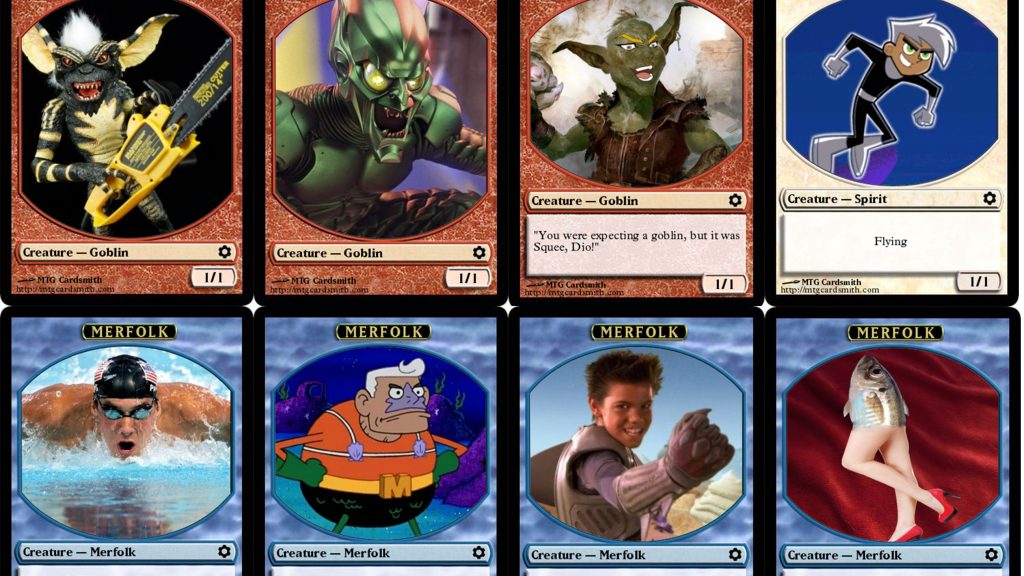
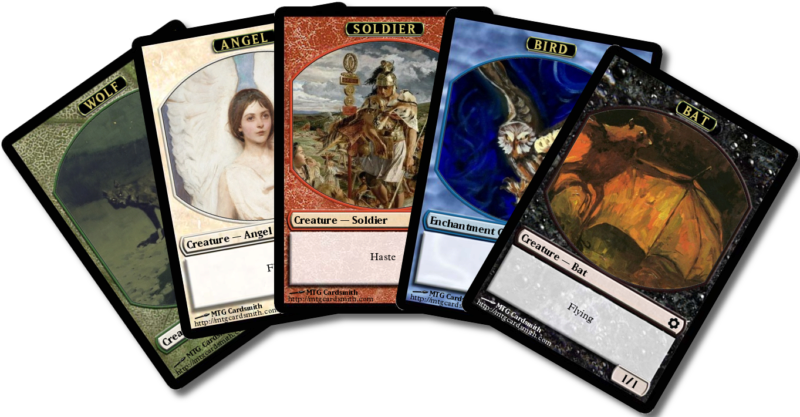
- Base piece: a token card, a printed proxy token, a labeled card, or an Infinitoken-style blank.
- Counter: dice, beads, paper clips, whatever. The counter is for quantity, not identity.
Dice are great at “how many.” Dice are terrible at “what is it.”
Good / Better / Best token setups
| Setup | What it looks like | Pros | Cons | Best for |
|---|---|---|---|---|
| Good | A labeled scrap/card + dice | Cheap, fast | Still messy if you’re sloppy | Casual pods, testing nights |
| Better | Dedicated token cards (real or printed) + dice | Readable, less arguing | Needs a small token kit | Commander, token decks |
| Best | A “token sideboard” (10 to 30 token cards) + consistent counters | Smoothest games, least friction | You have to prep once | Heavy token decks, regular playgroups |
Token edge cases that deserve special handling
Copy tokens (Clones, Rite of Replication, etc.)
If the token is copying something complex, you need more than “it’s a copy.” Use one of these:
- A spare card (or proxy) of what it’s copying, set on the battlefield as the token.
- A write-in token where you jot the copied name and the key stats/abilities that matter right now.
Tokens with different abilities that “look the same”
Example: two tokens that are both 3/3s, but one has flying. Don’t represent both with identical dice. Give them different bases (two different token cards, or labeled markers), then add counters.
Transforming or double-faced tokens
Some tokens can change into a different token face. The clean play is:
- Have both faces represented (a double-sided token/proxy token is perfect), and physically flip/swap it when it changes.
- If you only have one face, use two distinct token bases and swap which one is on the battlefield.
If you’re thinking “I’ll just remember,” you will not. Nobody does. That’s why reminder text exists.
The “Token Kit” checklist (throw this in your deck box)
- 5 to 10 blank write-in tokens (or scraps/cards you can label)
- Your deck’s top 10 most common tokens (Treasure, Food, Clue, whatever your list actually makes)
- A small handful of matching dice (consistency beats style)
- One “weird token” solution for copies (spare proxy or write-in)
That’s it. No need to build a traveling art exhibit.
Double-faced cards: three clean approaches that work in real life
Double-faced cards are mainly a problem in two places:
- In your library and hand (hidden information)
- When they change faces (table clarity)
Here are the clean options, in order of least-to-most fiddly.
Option 1: Fully opaque sleeves (the “I want zero paperwork” method)
If your sleeves are truly opaque, you can just sleeve the card normally. When it transforms, you flip it. Easy.
Key point: “I think they’re opaque” and “they’re opaque” are different things. Hold a sleeved card up to a strong light. If you can make out the card back or a silhouette, you’re living dangerously.
Best for: players who already sleeve everything the same way and hate helper cards on principle.
Option 2: Substitute/checklist card in the deck (the “tournament-clean” method)
This is the sanctioned-friendly way to play double-faced cards without relying on sleeve opacity. You put an official substitute card (sometimes called a checklist card) in your deck, and keep the real double-faced card separate.
How it plays out:
- In hidden zones (library, hand): you’re holding a normal-backed substitute card.
- When it becomes public (stack, battlefield, graveyard, exile face up): you swap in the actual double-faced card.
Best for: anyone who plays at stores/events and wants a method that is both clean and rules-aligned.
Also: even in casual proxy play, this method is great. Use a clear “placeholder” in the deck and keep your double-faced piece ready to swap in when it matters.
Option 3: Double-faced proxies (the “just play the game” method)
If you’re using proxies casually, double-faced printing is the smoothest experience. You get both faces on one card, you flip it like normal, and nobody has to interpret your handwriting like it’s an ancient scroll.
Proxy King does offer double-faced printing for this exact reason. It removes the “where did I put the other side?” problem, which is honestly the most boring mini-game Magic ever invented.
Best for: casual Commander pods, cubes, and playtesting where you want maximum clarity and minimum fiddling.
Modal DFCs vs transforming DFCs: handle them slightly differently
Not all double-faced cards behave the same way.
Modal double-faced cards (MDFCs)
These are the ones where you choose which face to cast or play (spell on one side, land on the other, etc.). They don’t “transform” mid-battlefield. The clean issue is hidden information, not flipping constantly. Opaque sleeves or a substitute approach keeps everything fair.
Transforming double-faced cards
These are the werewolves, battles that convert, daybound/nightbound cards, and other “it changes later” designs. Here the clean issue is both hidden information and making flips obvious.
Practical tip: when a transforming card flips, announce it out loud and do the physical flip/swap immediately. The table should not need to remember what it used to be.
The sanctioned reality check (because someone will ask)
If you’re in a Wizards-sanctioned event, you generally need authentic cards. Player-made proxies are not allowed. The big exception people half-remember is judge-issued proxies, which are limited to specific situations (usually when a card is accidentally damaged or becomes marked during the event).
Double-faced cards in sanctioned play have their own clean rules:
- Use completely opaque sleeves, or
- Use official substitute/checklist cards.
Tokens and other game aids are flexible, as long as your representation is clear to both players.
So yes, your kitchen-table proxy setup can be immaculate, and still not be legal at FNM. Magic contains multitudes.
The Rule 0 script that prevents 95% of awkwardness
Use something short and normal. Do not make it a speech.
Try:
- “Quick heads up, I’m running a few proxies, plus some proxy tokens and a couple double-faced cards. Everything’s readable, and I’ll announce flips. Everyone cool with that?”
- “I’ve got double-faced pieces handled with opaque sleeves / placeholders. If anything’s unclear, tell me and I’ll fix it.”
If someone says no, that’s not an invitation to debate. It’s an invitation to switch decks or find a different pod. The goal is a good game, not a courtroom drama.
Pre-game “clean table” checklist
- Are your double-faced pieces not identifiable in the deck (opaque sleeves or substitutes)?
- Do you have the real back faces available (or double-faced proxies ready)?
- Do you have token bases for the important stuff, not just dice?
- Do you have a way to represent copy tokens clearly?
If you can answer “yes” four times, you are officially more prepared than most of us.
FAQs
Can I use proxy tokens instead of official MTG tokens?
In casual play, yes, and it’s usually better for clarity. In sanctioned play, tokens are game aids and you can generally use clear representations, but keep it unambiguous and non-misleading.
Do I need the real double-faced card if I’m using a proxy?
Casually, no, as long as your group is fine with proxies and the card is clearly represented. In sanctioned play, a substitute card requires you to have the actual double-faced card available to swap in when it becomes public.
Are double-faced cards allowed without opaque sleeves?
Yes, if you use official substitute/checklist cards. If you try to do neither, you’re basically asking for a marked-card problem.
Can I use proxies in tournaments?
In Wizards-sanctioned events, no, except for narrow cases where a judge issues a proxy for a damaged/marked card during the event. For everything else, assume “no” and save your proxies for casual nights.
What’s the cleanest way to handle transforming tokens?
Have both faces represented and flip or swap when it changes. If you only have one face, use two distinct token bases and swap which one is on the battlefield.