
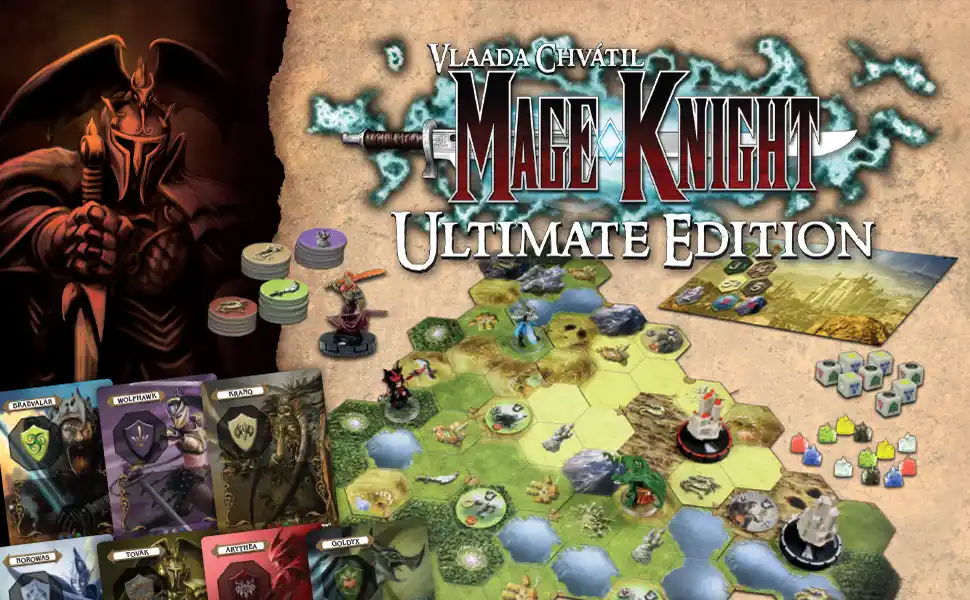
Mage Knight Ultimate board game has a strange reputation. People call it one of the best solo games ever made and also warn that it will melt your brain. That mix of hype and fear made me curious, so I started digging into what this giant box actually offers, how it plays, and who it is really for.
In this review I will walk through what comes in the Ultimate Edition, how the game feels at the table, and the real pros and cons so you can decide if Mage Knight Ultimate board game belongs on your shelf or if you are better off with something lighter.
What is Mage Knight Ultimate board game?
Mage Knight is a fantasy adventure game for 1 to 4 players where you control a powerful mage knight roaming a hex map, leveling up, building a deck of cards, and conquering cities. It mixes ideas from RPGs, deck building, and classic adventure board games into one very dense package.
The Ultimate Edition is a big all-in-one version. It includes the original base game plus all three expansions and a handful of new cards packed into a single box with an integrated rules set and updated miniatures. You are not missing content with this version. If anything, you might be getting more than you can realistically explore in a year.
On BoardGameGeek the game sits at the heavy end of the complexity scale with a weight rating above 4 out of 5, and the listed playtime runs from about an hour per simple scenario up to four hours or more for big ones. It is a “clear the table and commit” game, not a quick filler.
What is inside the Ultimate Edition box?
The box is huge. If you store games in Kallax cubes, this one is going to be awkward. Inside you get:
- All content from the base game
- The Lost Legion expansion
- The Krang character expansion
- The Shades of Tezla expansion
- Seven different mage knight characters with minis
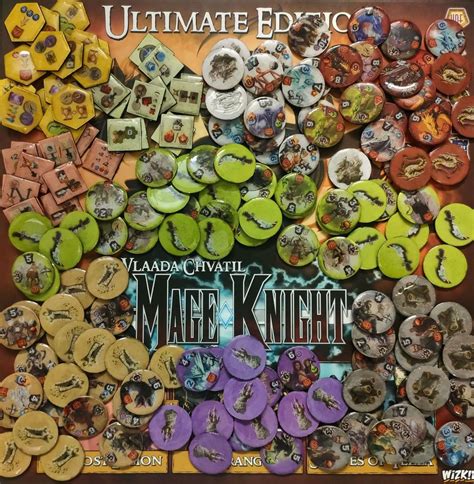
- A pile of map tiles, enemies, spells, skills, crystals, and tokens
- A thick integrated rulebook and scenario book
- Five new cards that did not exist in earlier printings
You also get alternate paint jobs on the minis compared to the original releases. They are not boutique miniature quality, but they look fine at arm’s length and help distinguish each hero on the map.
Component quality is a bit mixed depending on which printing you get. Many players report that the more recent Ultimate Edition printings have consistent card backs and better color matching than the old base-plus-expansions combo, which used to have noticeable differences between sets. Some people still complain that the cardboard finish and tokens feel more “functional” than premium. In short, it works, it is not ugly, but you will not buy this box just to admire the production.
How Mage Knight plays in practice
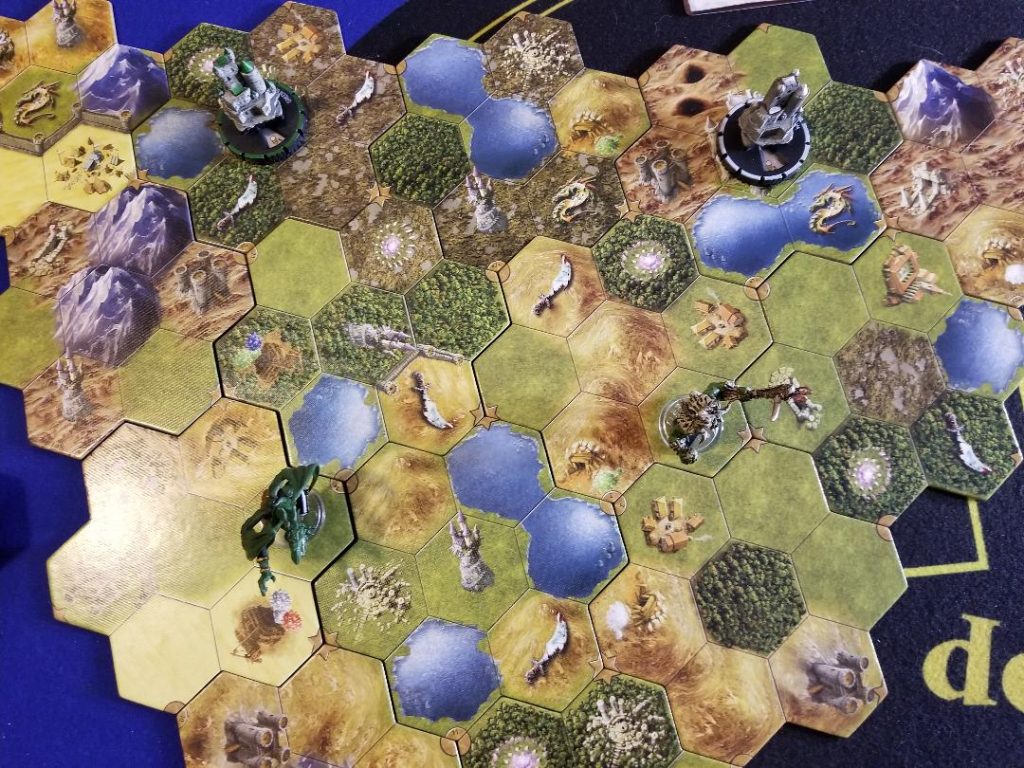
At its core the game is about using a small hand of cards in clever ways. Each card has multiple modes, such as simple movement or stronger movement if you spend mana. You move your hero over a hex map that you reveal bit by bit, flipping new tiles as you explore. The world fills up with villages, ruins, keeps, mage towers, and finally dangerous cities.
A turn usually goes like this:
- Draw a hand of cards from your deck
- Decide how to use them for movement, influence, attack, block, or special effects
- Resolve any combat against enemies you tried to fight
- Clean up and draw back up
You level up as you earn fame, which unlocks new skills, more armor, and stronger cards. There is a nice sense of growth as your character shifts from scraping together basic attacks to throwing out wild spell combos later in the scenario.
Scenarios set your main goal. Some ask you to conquer one or two cities. Others focus on racing an enemy general, exploring as far as possible, or beating a specific boss. With all expansions included you get a large set of scenarios with solo, co-op, and competitive options. That variety is a big reason people keep this game in their collection for years.
The flip side is length. Even a “simple” solo scenario is usually a two hour experience once you know the rules. Multi player games can stretch well past four hours, especially while everyone is still learning.
Solo, co-op, and competitive modes
Most people who love Mage Knight treat it as a solo game first. There is a reason it often ranks near the top of solo board game lists. You get a deep, puzzly experience where every turn is about squeezing maximum value from a tight hand of cards. There is no player downtime and no one waiting while you think.
Co-op scenarios exist and can be great if everyone at the table is comfortable with the rules. You each run your own mage knight but work toward a shared objective. The catch is that the game gets even longer and it is easy for one rules confident player to drift into quarterbacking.
Competitive play is there too, but most experienced players seem to treat it as a secondary mode. You technically can fight each other on the map, yet the rules for player versus player combat are more fiddly than fighting enemies, and the game is already complicated. Many groups end up playing “competitive, but no PvP” where you race for points and city conquests while mostly ignoring direct conflict.
As a rough guide, expect something like:
- Solo: 2 to 3 hours for a standard scenario once you know what you are doing
- Two players: 3 to 4 hours
- Three or four players: 4 to 6 hours and a lot of mental energy
This is not the box you pull out for a casual family night.
Complexity and learning curve
Let’s be blunt. Mage Knight is hard to learn. The rules are not impossible, but there are many small exceptions, timing windows, and day versus night differences that only show up in certain situations. That is a big part of why the complexity rating sits so high on BGG.
Early plays feel like this:
- First game: you are mostly reading the rulebook and getting basic movement and combat wrong
- Second game: you understand the flow but keep looking up small details
- Third or fourth game: the core rules finally click and the real puzzle starts
The integrated rulebook in the Ultimate Edition helps compared to the older system of two separate books, but it is still dense. Expect to use player aids and maybe a teaching video for your first session. Once the rules settle in your head, most of the complexity shifts from “what am I allowed to do” to “what is the smartest way to use my cards.”
If you enjoy heavy Eurogames or crunchy war games, this learning curve feels fair. If you are used to casual card games and mid weight strategy, it will feel like a wall.
Usability, rulebooks, and table presence
On the table, Mage Knight looks like a classic fantasy adventure: hex tiles, stacks of tokens, crystals, and a cluster of minis exploring the map. It is not as flashy as modern deluxe productions, but it has charm and the iconography is mostly clear once you learn it.
Table needs are real, though. You want a decent sized table, space for each player’s deck, skills, units, and discard area, plus a central area for the map and common supply. Setup and teardown are not lightning fast, especially with all expansions mixed in.
The integrated rulebook is thick, yet it organizes things reasonably. The main issue is still volume, not layout. Plan on bookmarking common sections or printing a concise rules summary from the fan community to reduce rulebook flipping.
Who will love Mage Knight Ultimate board game?
If any of this sounds appealing, you might be the target audience:
- You want a deep solo game that rewards repeated plays
- You like planning three turns ahead and solving multi step puzzles
- You do not mind games that run three or more hours
- You enjoy fantasy themes but care more about systems than story text
- You want an all in one box so you never worry about tracking down expansions later
For this type of player, Mage Knight Ultimate board game can easily become a “desert island” pick. It packs a huge amount of content and replayability into one purchase.
Who should probably skip it?
On the other hand, you may want to avoid it if:
- Your group prefers fast turns and lots of table talk
- You usually play with people who dislike reading rules
- Your typical game night window is around 60 to 90 minutes
- You hate tracking small rules exceptions or referencing a rulebook mid game
- You care more about story flavor and narrative choices than mechanical puzzles
Even within heavy strategy circles, some players bounce off Mage Knight because it feels like “homework after work.” That is not a knock on the design, just a mismatch of taste.
Final verdict
Mage Knight Ultimate Edition is not a perfect product. The box is oversized, component quality is workmanlike rather than luxurious, and the learning curve is steep. It asks a lot from you in terms of time, attention, and table space.
In return it gives you one of the most intricate solo and small group strategy games available, plus every major expansion in one package. When the rules finally click and you start chaining wild card combos to topple a fortified city on the final turn, it feels great in a way that lighter games simply cannot match.
If you are a heavy strategy or solo gamer looking for a long term project game, Mage Knight Ultimate board game is absolutely worth serious consideration. If you are unsure, I would think about how often you really want to dedicate three or four hours to one game. For the right player, this is a lifetime keeper. For the wrong player, it will just be an intimidating brick on the shelf.