
Best Cube Formats for Two Players
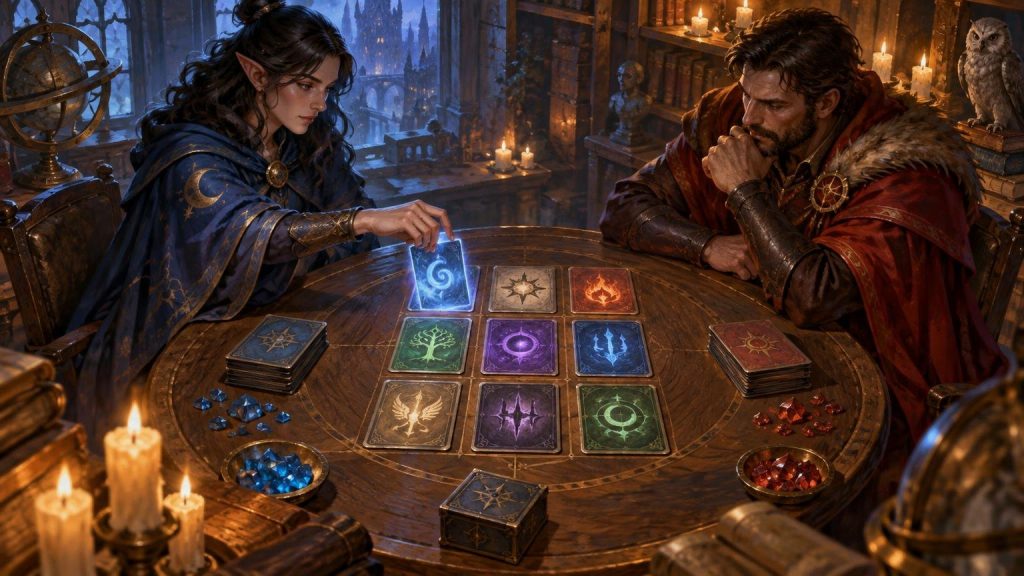
TLDR: Start with Grid Draft
Grid Draft is the best two-player Cube format for most groups. It is quick to teach, creates meaningful decisions, uses 162 cards, and gives both players complete information. Choose Housman or Pancake instead when you want focused decks and enough agency to support narrower archetypes. Winston is compact and pleasantly chaotic, Winchester is the simplest open-information alternative, and Cube Sealed is best when you want to start playing with minimal draft procedure.
The important question is not merely which format sounds clever. It is which format exposes enough of your Cube, gives players appropriate control over their pools, and produces decks that represent the environment you are trying to build. A brilliant graveyard package is just decorative cardboard if half of it disappears into an unseen discard pile.
The best two-player Cube formats compared
| Format | Cards used | Information | Best use |
|---|---|---|---|
| Grid Draft | 162 | Fully open | Best overall balance of speed and decisions |
| Winston Draft | 90 | Mostly hidden | Small Cubes and unpredictable drafts |
| Winchester Draft | Usually 80–90 | Fully open | Simple drafting with visible tradeoffs |
| Housman Draft | 171 | Partial | Focused decks and archetype testing |
| Pancake Draft | 198 standard; smaller variants exist | Open during each pack | High-agency drafting and detailed Cube evaluation |
| Cube Sealed | 180 total | Private pools | Fast setup and broad card-quality testing |
1. Grid Draft is the best all-purpose choice
In a standard Grid Draft, players work through 18 face-up grids of nine cards. One player chooses a row or column, the other takes a remaining row or column, and the final three cards are discarded. That uses 162 cards and makes the format suitable for a 180-card Cube with a little variance between sessions. Lucky Paper’s Grid Draft rules provide the complete procedure.
Grid succeeds because every selection asks several questions at once. Do you take the strongest card, secure two pieces of fixing, deny an obvious synergy card, or choose the row containing three merely useful playables? Both players can read the table, but neither can collect everything.
The weakness is that many cards are discarded. Narrow combinations therefore need redundancy. If an archetype requires one specific enabler and one specific payoff, Grid may ceremonially display both before throwing one into the void. Favor flexible cards, overlapping themes, and enablers that serve more than one deck.
2. Housman and Pancake are best for focused decks
Choose Housman when you want two-player decks that more closely resemble the focused decks produced by a larger draft pod. It uses 171 cards across nine rounds. Each player starts a round with five hidden cards and makes three exchanges with a shared nine-card display, eventually building a 45-card pool. It offers substantial agency without making every piece of information public.
Pancake Draft pushes agency even further. The standard version processes 18 packs of 11 cards, for 198 cards total. Each player drafts 45 cards while 108 cards are burned, but both players see every card as it is processed. CubeForge also documents reduced-pack variations for 180-card Cubes. CubeForge’s Pancake Draft walkthrough explains the pick-and-burn sequence.
These formats are my preference for evaluating archetype density. Players see or interact with enough material to make deliberate choices, so a failed reanimator, artifacts, or spells deck tells you more than it would after a low-agency draft. Housman has more procedure; Pancake consumes more cards. That is the price of getting better diagnostic information from the draft.
3. Winston and Winchester suit smaller, looser sessions
Classic Winston Draft uses 90 cards divided through three face-down piles. A player inspects piles in sequence, taking one or adding a card and moving on. After declining all three piles, that player takes an unknown card from the deck. Richard Garfield designed it as a more random two-player alternative that reduced the intense tracking and disruption possible in other heads-up drafts. Wizards’ original Winston Draft explanation gives the official classic structure.
Winston is excellent when portability and discovery matter more than assembling polished archetypes. Its constrained choices can produce weaker, less focused decks, which also makes individual Cube changes harder to evaluate. Do not build a Winston-first Cube around combinations that need three exact cards to meet for coffee.
Winchester turns that uncertainty face up. Four visible piles receive one card apiece; a player takes one pile, and then every pile receives another card. Common versions use 80 cards, although 90-card versions also exist. The growing piles create a clean quality-versus-quantity decision, but pool quality can become uneven.
4. Cube Sealed is the lowest-friction option
For Cube Sealed, give each player 90 random cards and build 40-card decks using basic lands. It removes draft procedure and works well when time is limited or one player is still learning the Cube.
Sealed tests broad card quality, deck construction, fixing, and the resilience of your themes. It is less reliable for narrow packages because a random pool may separate the necessary pieces. Use mechanics with numerous interchangeable enablers and payoffs rather than expecting one tiny combo to report for duty.
Build the Cube for the format you actually play
A 180-card Cube is a practical starting point for two players, but format determines whether a session uses 80 cards, 90 cards, 162 cards, 171 cards, 180 cards, or more. That difference should shape card roles and archetype density.
- Use redundant enablers for important themes. If sacrifice matters, include several sacrifice outlets rather than one glamorous build-around.
- Prioritize flexible removal, card draw, curve-filling creatures, and fixing. These cards keep decks functional when a draft format hides or burns key selections.
- Let cards support multiple archetypes. A discard outlet that also enables reanimator and spells-matter decks is more reliable than an isolated tribal payoff.
- Audit mana by watching games. Track missed colors, uncast cards, awkward opening hands, and whether fixing is routinely discarded before either player can select it.
- Change a few cards at a time. Cube design is iteration, not an emergency meeting where 40 cards are fired before lunch.
Lucky Paper suggests 10–20% fixing lands as a broad starting range for a first Cube, but the real test is whether decks cast their spells in your chosen format. Grid burns cards, Winston restricts access, and Housman provides more deliberate selection. The same nominal fixing percentage can perform differently in each environment.
If mana is the recurring problem, start by reviewing how to proxy a mana base without warping the test. For a larger physical build or repeated iterations, ProxyFoundry MTG proxies and playtest-card printing can provide a practical route for assembling the cards. Use proxies transparently in casual Cube sessions where the group permits them.
A practical testing rotation
Begin with three Grid Drafts because it is the strongest general baseline. Record which colors are drafted, which cards are repeatedly discarded, whether each deck reaches enough playables, and how often players can cast spells on curve. Then run one Housman or Pancake Draft. If a theme succeeds only in the higher-agency format, it may need more density for regular Grid play.
Use Winston as a stress test for flexible card quality and Sealed as a check on fixing and broad synergy. Do not expect every format to produce the same decks; that difference is the useful part. For most two-player Cubes, Grid should be the regular format, with Housman or Pancake used whenever you need a closer look at whether your archetypes actually work.
References
Share this Post
Product Categories
- Lorcana3535 products
- MTG Proxy Cards23032303 products
- MTG Proxy Sets2323 products
- Artifact351351 products
- Black310310 products
- Blue261261 products
- Colorless6666 products
- Green283283 products
- Land MTG Proxy Cards444444 products
- Multi-Colored202202 products
- Red176176 products
- White212212 products
- Pokemon2626 products