
TLDR
- Gold-bordered cards are real Wizards-printed products, but they are not tournament-legal for sanctioned play.
- In sanctioned events, gold-bordered cards do not count as “allowed proxies.” The only proxies that exist in sanctioned play are judge-issued and temporary.
- In casual Commander and kitchen table, gold-bordered cards are often treated like proxies, but it’s still a Rule 0 conversation.
- If you want fewer awkward moments, ask first, sleeve opaque, keep them readable, and don’t try to “upgrade” them into looking tournament-legal.
You found a gold-bordered Gaea’s Cradle for a fraction of the “real” price. You felt clever. The free market trembled. Then someone at the table squints and goes, “Uh… is that a proxy?”
Congrats. You’ve discovered Magic’s favorite mini-game: card legality, but with vibes.
Let’s answer the actual question: are gold-bordered cards proxies, and what changes between casual play and sanctioned events?
Are gold-bordered cards proxies in MTG?
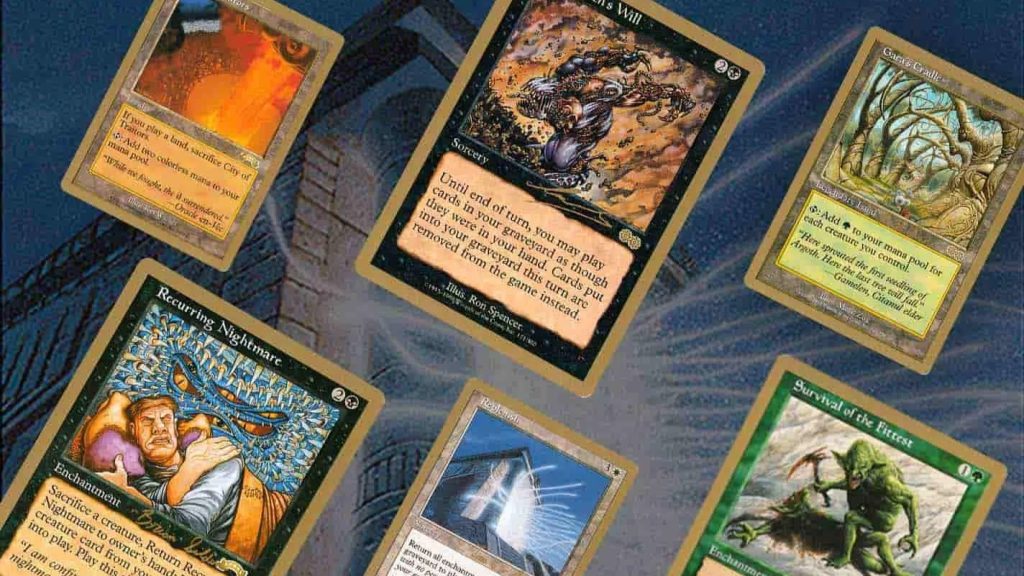
Strictly speaking: gold-bordered cards are not “proxies” in the sense of being homemade stand-ins. They’re official Wizards-printed cards from special products.
Functionally: they often behave like proxies because they aren’t legal for sanctioned tournaments, so the only places you play them are the same places you play proxies: casual pods, unsanctioned nights, cubes, and playtesting.
The cleanest way to think about it is this:
- Gold-bordered = official printings, unofficial game pieces (for sanctioned play).
- Proxy (common usage) = any stand-in used because you don’t want to buy, carry, or risk the original.
- Proxy (tournament rules) = a very specific thing a judge issues, under very specific conditions.
And that last bullet is where people get burned.
Two different “gold-bordered” things people mean
When someone says “gold-bordered,” they usually mean one of these:
1) World Championship Deck cards (gold border on the front)
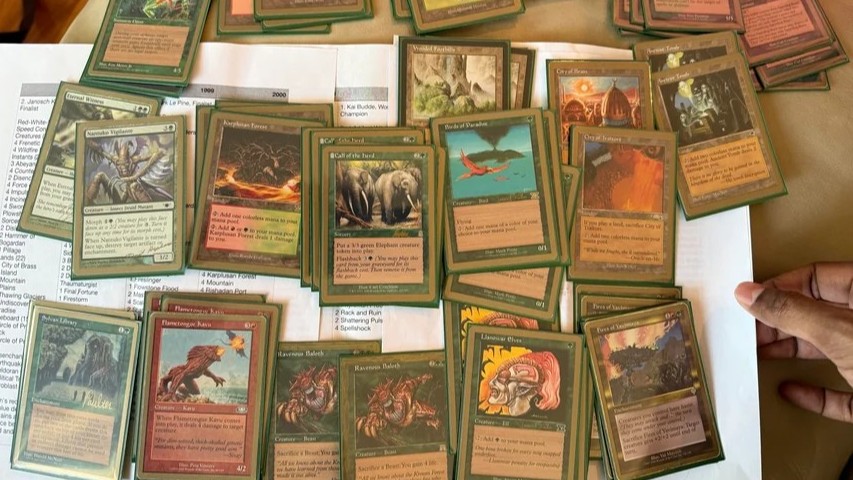
These are the old “replica deck” cards, with a gold border on the face and a non-standard back. They’re famous because they include iconic staples and were sold as commemorative products.
2) Collector’s Edition / International Edition (gold border on the back, often square corners)
These look closer to normal on the front, but the back and corners give them away. They’re also clearly meant as collector items, not tournament game pieces.
Tournament policy does not really care which flavor you brought. Gold border on front or back still lands you in the same bucket.
Sanctioned play: it’s a hard no (and sleeves don’t “fix” it)
If the event is sanctioned, you should assume gold-bordered cards are not allowed, full stop.
Why? Because sanctioned Magic uses the Magic Tournament Rules. Those rules define what counts as an “Authorized Game Card,” and they explicitly exclude cards that (unaltered) have gold borders on the front or back. So even though they’re printed by Wizards, they are still not authorized for sanctioned events.
And no, opaque sleeves do not magically convert them into authorized cards. Sleeves can help prevent marked cards. They don’t rewrite policy. (If sleeves rewrote policy, Commander players would have legalized a lot of things by now.)
“But my store’s Commander night is casual”
Cool. It might still be run as a sanctioned event through official reporting. “Casual vibe” and “sanctioned policy” can coexist, because reality is messy like that.
So the practical rule is:
- If it’s sanctioned, treat it like tournament policy applies.
- If you’re not sure, ask the organizer before you shuffle. (Yes, before. Not after you keep a hand with a gold-bordered dual and a confident smile.)
Proxies in sanctioned events: what’s actually allowed
This is the part that clears up 90% of confusion.
In sanctioned play, a “proxy” is not “a stand-in you brought from home.” A proxy is a judge-issued replacement for a card that became unusable in the tournament, and it comes with tight limits:
- It’s only issued for specific reasons (like accidental damage during the event).
- Players can’t create their own.
- It’s valid only for that tournament.
So if you show up with gold-bordered cards and call them “official proxies,” tournament policy responds with the classic Magic ruling: nice try, that doesn’t work.
Casual play: gold-bordered cards are “Rule 0 legal” if your group agrees
Casual play is where gold-bordered cards actually shine, because they’re:
- readable
- durable enough to shuffle
- and way less likely to look like a counterfeit (because they’re loudly not tournament legal)
That said, even in casual Commander, there’s a default expectation in the wider community that people use normal cards. The Commander Rules Committee frames gold-bordered and similar oddball cards as not intended for normal games without prior approval, which basically translates to: ask first, don’t surprise people.
So the answer in casual is usually:
- Many pods are fine with them.
- Some pods are not.
- The difference is a 20-second conversation that saves everyone 20 minutes of weirdness.
The “Can I play this tonight?” decision tree
Use this and you will look like a functional adult who plays a children’s card game.
- Is the event sanctioned?
If yes: don’t bring gold-bordered cards. Bring legal cards. Or bring a different deck. - If it’s not sanctioned, is it a store night with prizes?
If yes: ask the organizer anyway. Prizes make people care. Not always, but often. - If it’s open play or a casual pod, do a quick Rule 0 check:
“I’ve got a few gold-bordered cards (official prints, not tournament legal). Everyone cool with that?” - If someone says no:
You switch decks, swap those cards, or find a different table. You do not file a Supreme Court brief about cardboard accessibility at table three.
Quick Rule 0 scripts you can copy-paste
If you’re sitting with strangers
“Quick heads-up: I’m running a couple gold-bordered cards (official Wizards prints, not tournament legal). They’re sleeved and readable. Everyone cool with that?”
If you’re at an LGS night
“Is tonight sanctioned or casual? If it’s casual, are gold-bordered cards okay? I can swap them if not.”
If you want to be extra chill
“If anyone hates it, totally fine, I’ll switch. I’m here for games, not proxy discourse.”
Gold-bordered vs proxy vs counterfeit: a quick comparison table
| Thing | Printed by Wizards? | Tournament legal (sanctioned)? | Typical casual acceptance | The social risk |
|---|---|---|---|---|
| Gold-bordered (WCD / CE / IE) | Yes | No | Often yes (ask first) | Low, because it’s obviously not “real” |
| Playtest / homemade proxy | No | No | Often yes (ask first) | Medium, if unreadable or “surprise” |
| Judge-issued proxy | Created by judge | Yes (only for that event) | N/A | Low, it’s official for that tournament |
| Counterfeit | No | No | Not acceptable | High, and crosses ethical lines |
If you remember one thing: gold-bordered cards are the least sketchy “proxy-like” thing you can play, because they’re not trying to fool anyone.
The one thing you should not do
Do not “fix” gold-bordered cards to look tournament legal.
Not “just for fun.” Not “only for my deck.” Not “because I own the real one.”
That’s the moment where a harmless conversation about casual play turns into “are we doing counterfeits now?” and nobody wins that table politics war.
FAQs
Are World Championship (gold-bordered) cards legal in Commander?
Not by default in any official tournament sense, but in casual Commander they’re commonly treated as acceptable if your group agrees. Ask first.
Are Collector’s Edition / International Edition cards legal anywhere?
Not in sanctioned tournament play. In casual play, some groups allow them the same way they allow proxies. Expect to need opaque sleeves.
Can I use gold-bordered cards at Friday Night Magic?
If it’s a sanctioned event, assume no. Some FNMs are casual in vibe but still run under sanctioned policy. Ask the store.
If my real card gets damaged, can I use my gold-bordered copy as a “proxy”?
In sanctioned play, proxies are judge-issued and the judge decides what’s acceptable. Bringing your own stand-in usually does not qualify. Keep the damaged original and call a judge.
Are gold-bordered cards “real cards”?
They’re real Wizards products, but they are not “authorized game cards” for sanctioned events. Real printing, different rules bucket.