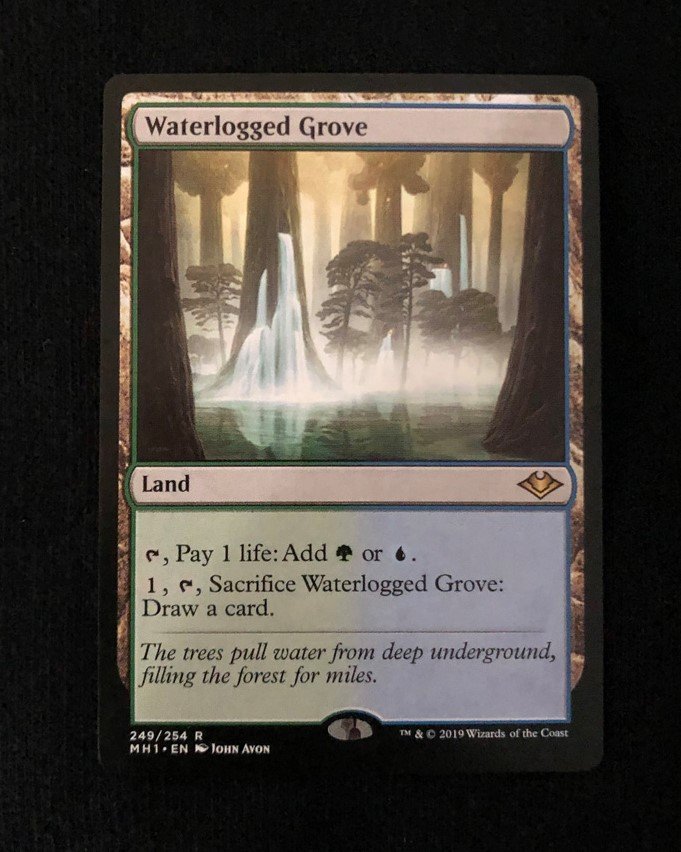
 , Pay 1 life: Add
 or
 .
 ,
Waterlogged Grove offers green-blue decks an untapped source of either color that can later become a card. Each colored mana activation costs one life, while paying one mana, tapping it, and sacrificing it draws a card. That makes the land useful early for flexible colors and later as a way to exchange excess mana infrastructure for another piece of action.
Land-recursion decks can use Life from the Loam to recover the sacrificed Grove or Crucible of Worlds to play it from the graveyard. Aesi, Tyrant of Gyre Strait can reward the replayed land with another draw, while extra land-play effects help support the repeated cycle. Each use still consumes a land play and mana, so the engine needs sufficient development to operate comfortably.
The draw ability can be activated during another player's turn, letting you wait until your available mana is no longer needed for interaction. Sacrificing the Grove too early can leave you unable to cast a larger spell later, so compare the value of the next card with the value of keeping access to both colors.
Repeated life payments can also add up alongside fetch lands and other painful sources. The Grove is most appealing when the deck can use its flexibility without leaning on it for every mana payment across a long game. Include it when drawing from a land slot or recurring a sacrificed land directly supports the strategy, rather than treating the draw mode as an automatic action whenever spare mana appears.